
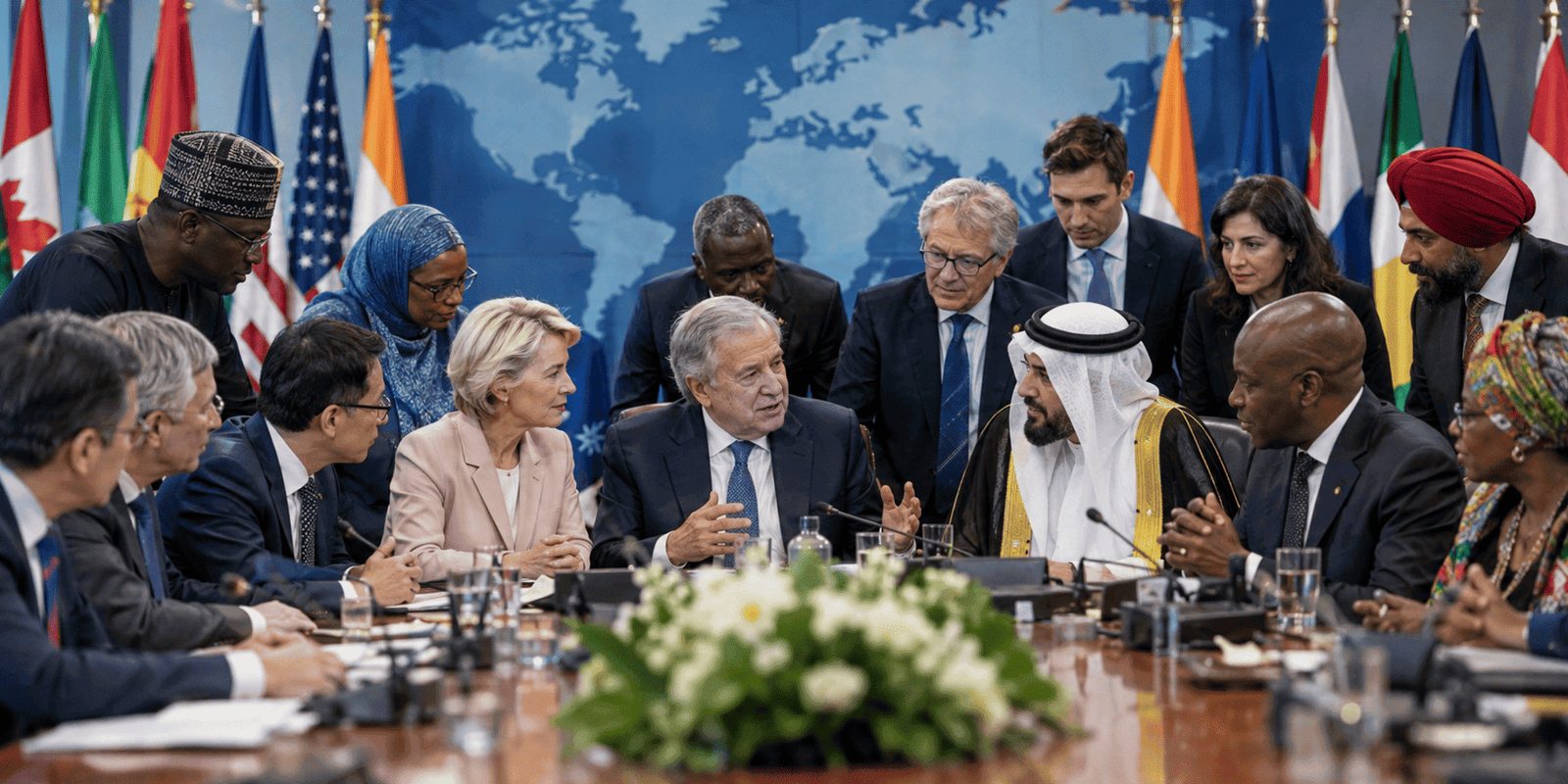
In an increasingly interconnected world, peace and international cooperation are no longer simply diplomatic ideals. They are essential conditions for economic stability, human security, sustainable development, and the protection of human rights.
Yet international politics is increasingly shaped by geopolitical rivalry, armed conflict, economic insecurity, mistrust, and competition over resources. Against this backdrop, the world needs a political vision that places dialogue above confrontation, prevention above escalation, and cooperation above zero-sum competition.
Such a vision does not mean ignoring national interests or legitimate security concerns. Rather, it means recognizing that lasting security cannot be built through military power alone. It requires diplomacy, strong institutions, inclusive development, respect for international law, and sustained cooperation among states and societies.
Quick Facts
- The United Nations Charter calls on states to settle international disputes by peaceful means and identifies international cooperation as a central purpose of the UN.
- Global military expenditure reached approximately $2.89 trillion in 2025, according to the Stockholm International Peace Research Institute (SIPRI), marking the 11th consecutive year of growth.
- The joint UN–World Bank Pathways for Peace study found that preventing violent conflict requires sustained, inclusive action addressing exclusion, institutional weaknesses, and other underlying sources of instability.
- Prevention, dialogue, inclusive governance, and development can complement traditional security policies by addressing risks before they develop into full-scale crises.
Why the World Needs a New Political Vision
The international system was built around the idea that states can protect their interests while cooperating on shared challenges. Today, however, many problems cross borders by nature.
Climate change, pandemics, migration, cyber threats, food insecurity, energy security, terrorism, economic instability, and armed conflicts cannot be managed effectively by individual countries acting alone.
At the same time, the growth of military expenditure demonstrates the persistence of insecurity. SIPRI estimates that global military spending rose by 2.9% in real terms in 2025, reaching its highest recorded level in its data series.
Military capabilities remain relevant to national defence, but a sustainable international order cannot depend primarily on deterrence and competition. Security must increasingly be understood as a shared responsibility.
Key Research Findings
Research from international institutions points to several important lessons.
1. Conflict prevention is more effective than crisis management
The Pathways for Peace study by the United Nations and World Bank emphasizes the importance of identifying and addressing conflict risks before violence becomes entrenched. It highlights the relationship between political exclusion, weak institutions, inequality, insecurity, and violent conflict.
This suggests a fundamental shift in political thinking: governments and international organizations should invest more consistently in early warning, mediation, inclusive institutions, and preventive diplomacy rather than waiting until crises become emergencies.
2. Inclusion strengthens the foundations of peace
Peace is difficult to sustain when large sections of society feel excluded from political decision-making, economic opportunities, justice, or public institutions.
The UN–World Bank research therefore emphasizes inclusive approaches to conflict prevention, including meaningful participation by women and young people.
Political systems that create space for different communities to participate peacefully are better positioned to manage disagreements without violence.
3. International law provides a framework for cooperation
The UN Charter establishes principles of sovereign equality, peaceful dispute settlement, and cooperation on international economic, social, cultural, and humanitarian problems.
International law cannot eliminate every conflict, but it provides essential rules for managing disagreements and limiting the use of force. Respect for these rules is therefore an important foundation for a more predictable international order.
The Main Causes of International Tension
A credible peace-oriented political vision must confront the forces that drive instability rather than simply calling for peace.
Among the major causes are :
- Geopolitical rivalry and competition for strategic influence.
- Political exclusion and weak democratic institutions.
- Economic inequality and unequal access to opportunity.
- Competition over natural resources, including land, water, and energy.
- Nationalism and polarization that portray compromise as weakness.
- Misinformation and disinformation that deepen social and international mistrust.
- Protracted armed conflicts that create cycles of retaliation and insecurity.
- Weak international coordination when governments pursue narrow short-term interests.
These factors often reinforce one another. Economic hardship can deepen political grievances; political exclusion can increase instability; and instability can fuel militarization and further weaken economic development.
What a Peace-Oriented Political Vision Should Prioritize
A practical vision for international peace and cooperation should be built around several interconnected priorities.
1. Put diplomacy at the centre of foreign policy
Diplomacy should not be treated merely as an instrument used after military or political confrontation has already escalated.
Governments should strengthen :
- Preventive diplomacy
- Mediation and negotiation
- Regional dialogue
- Confidence-building measures
- Direct communication between rival states
- Multilateral institutions
Dialogue does not require governments to abandon their interests. It creates mechanisms through which competing interests can be managed without resorting to violence.
2. Strengthen multilateral institutions
International organizations remain imperfect, but weakening multilateral cooperation would make many global problems harder to manage.
A stronger multilateral system should promote :
Accountability, transparency, peaceful dispute resolution, international law, and meaningful participation by states and affected communities.
Reform should focus not simply on preserving institutions but on making them more representative, responsive, and capable of addressing contemporary challenges.
3. Make prevention a long-term investment
Peacebuilding should begin long before violence erupts.
Governments and international partners should invest in :
- Early-warning systems
- Local conflict-resolution mechanisms
- Inclusive political institutions
- Independent justice systems
- Youth employment and education
- Women’s participation in peace and political processes
- Economic development in vulnerable communities
- Cross-border cooperation
The central principle is simple : address grievances before they become crises.
4. Link security with sustainable development
Security cannot be separated from economic and social conditions.
A population facing unemployment, weak public services, corruption, exclusion, and insecurity is more vulnerable to political instability. Conversely, inclusive economic development can strengthen social cohesion and reduce some of the conditions that allow conflict to grow.
This is why peace policy should not be confined to defence ministries and diplomatic institutions. Education, economic policy, justice, health, climate policy, and development cooperation are also components of peacebuilding.
5. Build cooperation around shared global challenges
Countries with serious political disagreements can still cooperate where their interests overlap.
Potential areas include :
- Climate adaptation
- Water management
- Food security
- Public health
- Scientific research
- Disaster response
- Energy security
- Maritime safety
- Cross-border infrastructure
- Cybersecurity
Practical cooperation can create channels of communication even when political relations are strained.
From a Culture of Confrontation to a Culture of Cooperation
A lasting transformation requires more than government-to-government agreements. It also requires a change in political culture.
Political leaders often gain domestic support by presenting international relations as a contest between winners and losers. Such rhetoric can make compromise politically costly.
A culture of cooperation takes a different approach. It recognizes that countries can compete economically and politically while still cooperating on matters where their interests are shared.
This does not mean ignoring genuine disagreements. It means creating political systems in which disagreement does not automatically become hostility.
Comparison : Two Approaches to International Politics
| Confrontation-oriented approach | Cooperation-oriented approach |
|---|---|
| Crisis management after escalation | Conflict prevention and early action |
| Zero-sum thinking | Shared interests and mutual benefit |
| Military power as the primary security tool | Diplomacy, development, and credible security together |
| Short-term political gains | Long-term stability |
| Limited participation | Inclusive decision-making |
| Rivalry between institutions | Multilateral coordination |
| Reaction to conflict | Addressing root causes |
Neither approach suggests that states should abandon national defence or legitimate security interests. The difference lies in the broader understanding of what creates lasting security.
The Role of Young People and Civil Society
Peace is not produced solely in presidential offices, foreign ministries, or international organizations.
Young people, civil society organizations, educators, researchers, journalists, businesses, and local communities all influence the political culture in which conflicts either escalate or are resolved.
Young people in particular should be treated not merely as beneficiaries of peacebuilding but as participants in it. Education in critical thinking, media literacy, civic responsibility, intercultural dialogue, and conflict resolution can help societies resist polarization and misinformation.
Independent journalism also has an important role. Responsible reporting can expose abuses, challenge propaganda, verify claims, and create space for informed public debate.
The Main Results We Should Aim For
A successful peace-oriented political vision should produce measurable outcomes rather than remain a collection of ideals.
Its main objectives should include :
- Fewer armed conflicts and lower civilian suffering
- Earlier diplomatic intervention in emerging crises
- Greater respect for international law
- Stronger regional and international institutions
- More inclusive political participation
- Improved economic opportunities in fragile communities
- Greater cooperation on transnational challenges
- Reduced dependence on military escalation
- Stronger public trust in institutions and diplomacy
The objective is not to create a world without disagreement. Such a goal would be unrealistic. The objective is to create a world in which disagreement can be managed without becoming war.
Conclusion : Peace as a Political Strategy
A political vision centred on peace and international cooperation should not be dismissed as idealistic. In a world where conflicts increasingly generate economic, humanitarian, environmental, and security consequences beyond national borders, cooperation is also a practical strategy.
The evidence points toward the value of conflict prevention, inclusive institutions, diplomacy, development, and international cooperation. At the same time, rising military expenditure shows that governments continue to face profound security concerns.
The challenge, therefore, is not to choose between security and peace. It is to build a broader understanding of security in which peace is itself a strategic objective.
The political leaders of the future will be judged not only by how effectively they defend national interests, but also by whether they can prevent crises, build partnerships, and create conditions in which cooperation becomes more attractive than confrontation.
Peace is not the absence of political disagreement. It is the capacity of societies and nations to resolve disagreement without destroying one another. A stronger commitment to that principle could provide the foundation for a more stable, cooperative, and resilient international order.
Leave a Reply