
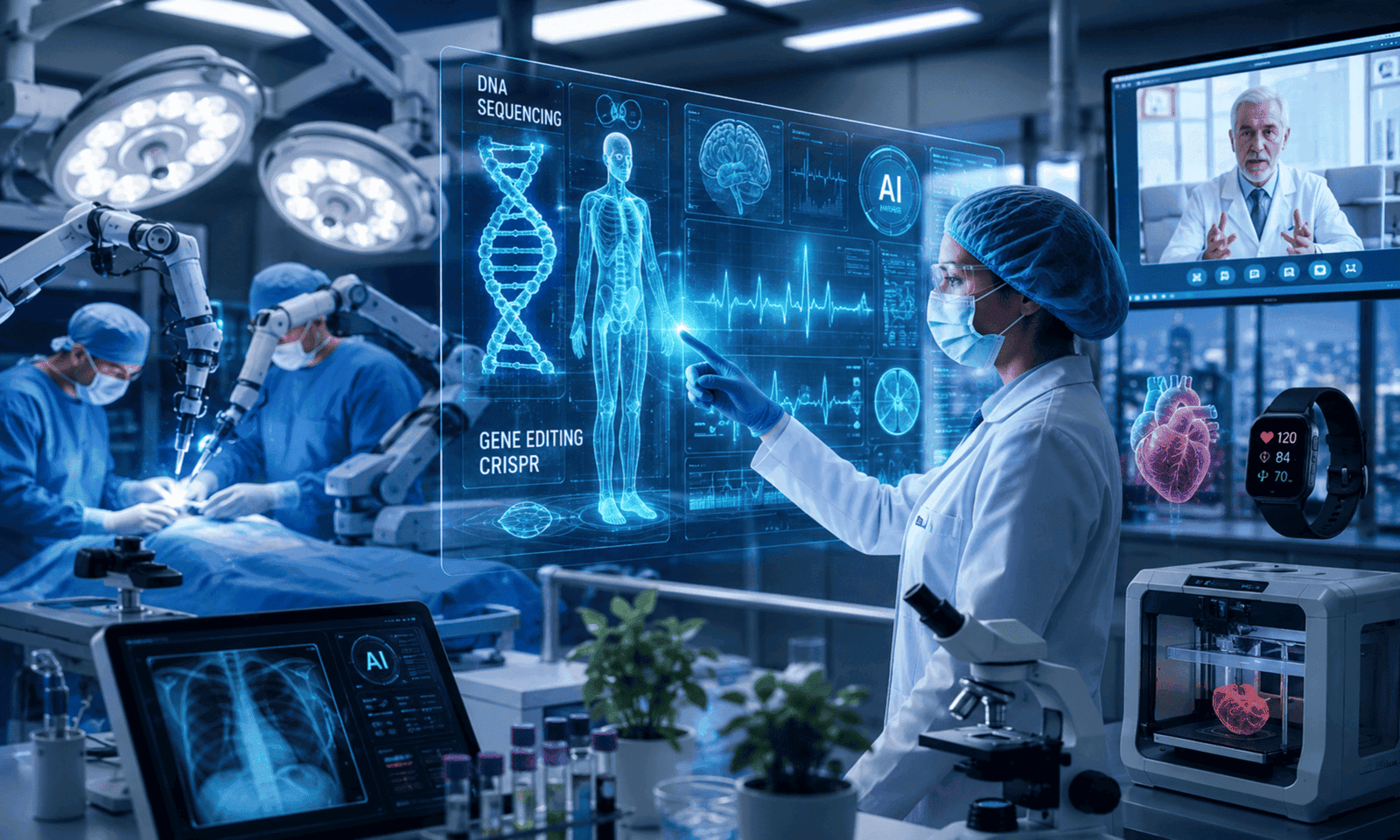
Healthcare is entering a period of rapid transformation. Advances in artificial intelligence, gene editing, precision medicine, digital health, medical devices, and biotechnology are changing how diseases are detected, treated, and monitored. Some technologies are already being used in clinical practice, while others remain under investigation.
The most important shift is not simply the arrival of new machines or medicines. It is the move toward more personalized, data-driven, preventive, and targeted healthcare. At the same time, regulators and health systems face a difficult challenge : ensuring that promising technologies are safe, effective, affordable, and accessible.
Quick Facts
- Artificial intelligence (AI) is increasingly being used for medical imaging, clinical decision support, drug development, administration, and health-system management.
- The U.S. Food and Drug Administration (FDA) reported more than 1,300 AI-enabled medical devices authorized to date in its 2025 annual report.
- CRISPR-based gene editing has moved from laboratory research into approved medical treatment. In the United States, Casgevy is approved for certain patients with sickle cell disease and transfusion-dependent beta-thalassemia.
- Patient-derived organoids are being investigated as models for drug testing and personalized treatment decisions.
- WHO emphasizes that healthcare innovation must be accompanied by strong governance, patient safety, equity, privacy, and ethical safeguards.
1. Artificial Intelligence Is Changing Diagnosis and Clinical Care
Among the most visible medical innovations, artificial intelligence is moving from research laboratories into hospitals and clinics.
AI systems can analyze large volumes of medical information, including imaging, laboratory results, electronic health records, and other clinical data. In some applications, they can help clinicians identify abnormalities that might otherwise be difficult to detect.
The trend is already measurable. According to WHO’s 2025 assessment of the European Region, 32 countries, or 64% of respondents, reported using AI-assisted diagnostics, particularly in medical imaging and disease detection.
AI is also being explored beyond diagnosis. Potential applications include:
- Medical image analysis
- Clinical decision support
- Drug discovery and development
- Patient communication
- Administrative automation
- Disease surveillance
- Personalized treatment planning
The FDA is also using AI internally. In 2025, the agency reported completing a generative-AI pilot for scientific review and subsequently launching an agency-wide AI tool designed to help staff analyze information and reduce repetitive work.
The challenge : AI must remain accountable
AI does not automatically produce reliable medical decisions. Poor-quality or biased data can produce misleading results, while unclear accountability can create problems when an AI-supported decision is wrong.
WHO therefore stresses the importance of human oversight, transparency, data governance, safety standards, and ethical regulation as AI adoption accelerates.
2. CRISPR and Gene Editing Are Moving Toward Targeted Treatment
Few developments have generated as much excitement in medicine as gene editing.
CRISPR-Cas9 allows scientists to make targeted changes to DNA. Instead of treating only the symptoms of certain genetic diseases, gene-editing therapies aim to address biological mechanisms underlying the disease.
A landmark example is Casgevy (exagamglogene autotemcel). The FDA approved the therapy in 2023, making it an important milestone for CRISPR-based medicine. It is now indicated for patients aged 12 and older with sickle cell disease involving recurrent vaso-occlusive crises and for transfusion-dependent beta-thalassemia.
FDA clinical review data found that most participants treated for sickle cell disease were free from severe vaso-occlusive crises for at least 12 months, although the treatment involves significant risks and requires long-term monitoring.
The next stage could be even more personalized. In 2026, the FDA issued draft guidance addressing the development of individualized therapies for ultra-rare diseases, including genome-editing and RNA-based treatments.
This points toward a future in which therapies could be designed around the specific genetic cause of an individual patient’s disease.
3. Precision Medicine Is Becoming More Individualized
Traditional medicine often relies on treatments that work for large groups of patients. Precision medicine takes a different approach by using information about an individual’s genes, biology, disease characteristics, and sometimes treatment response to guide care.
Advances in genomic sequencing and data analysis are making it easier to identify biological differences between patients who appear to have the same disease.
One promising development is the use of patient-derived organoids. These are three-dimensional cellular models grown from patient tissue and designed to reproduce some characteristics of human organs or tumors.
Research published in 2025 described patient-derived organoids as promising tools for drug discovery and personalized medicine, while also highlighting limitations involving reproducibility, scalability, and their inability to reproduce every aspect of a functioning human organ.
In another study involving pituitary neuroendocrine tumors, researchers successfully established patient-derived organoids from tumor samples and used them for drug-response testing.
The long-term goal is compelling : rather than relying exclusively on trial and error, doctors may eventually be able to test selected treatments against a patient’s own disease model before deciding which therapy is most appropriate.
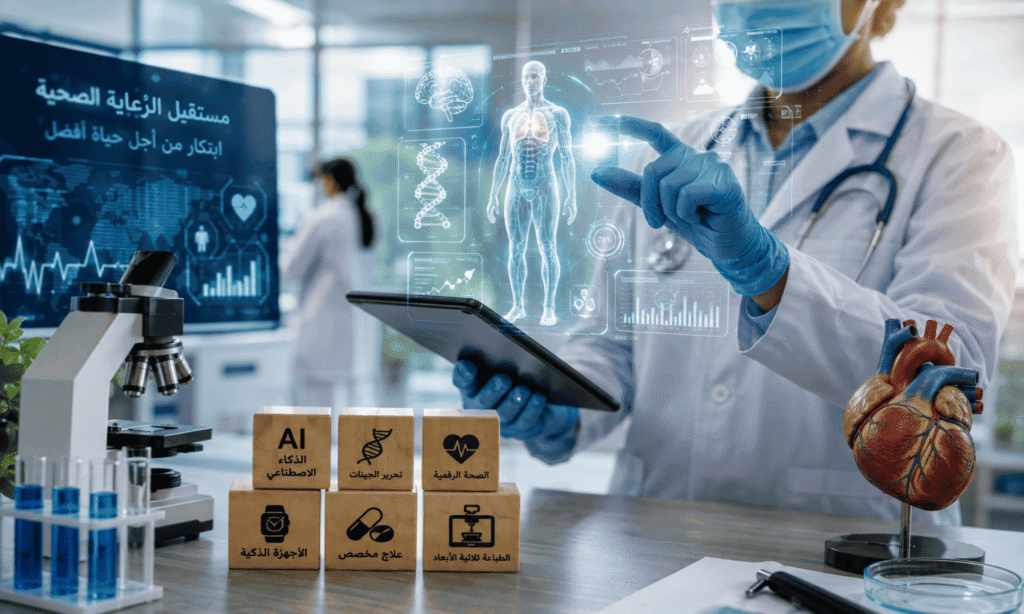
4. Digital Health and Wearable Devices Are Moving Care Beyond the Hospital
Healthcare is also becoming increasingly connected.
Wearable devices, remote monitoring technologies, connected sensors, and telehealth platforms can collect health information outside traditional clinical environments. Depending on the device and its intended use, this may include heart rate, activity, glucose measurements, sleep patterns, oxygen levels, or other physiological signals.
This creates opportunities for continuous or remote monitoring, particularly for chronic diseases.
Instead of receiving a snapshot of a patient’s condition during an occasional appointment, clinicians may increasingly have access to information collected over longer periods.
However, more data does not automatically mean better healthcare. Digital tools must demonstrate clinical value, protect sensitive health information, and be usable by people with different levels of technological access and literacy.
WHO notes that medical technologies are already used across settings ranging from hospitals to homes and remote clinics, supporting prevention, diagnosis, monitoring, treatment, and rehabilitation.
5. Advanced Medical Devices Are Expanding What Clinicians Can Do
Medical-device innovation is another major force reshaping healthcare.
Modern devices increasingly combine sensors, imaging, software, robotics, artificial intelligence, and minimally invasive techniques. The result is a growing category of technology-enabled care that can assist clinicians while potentially reducing the physical burden of some procedures.
The FDA’s 2025 annual report illustrates the pace of development. During that year, 44 breakthrough devices received marketing authorization, including devices addressing areas such as Alzheimer’s diagnosis and pediatric myopia. The FDA also reported more than 1,300 AI-enabled medical devices authorized to date.
These developments demonstrate an important trend: medical innovation is no longer limited to pharmaceuticals. Software and intelligent devices are increasingly becoming part of the treatment and diagnostic infrastructure itself.
6. 3D Printing Is Enabling More Customized Medical Solutions
3D printing in healthcare has developed from a niche technology into a broader research and clinical field.
Three-dimensional printing can be used to create customized anatomical models, surgical planning tools, prosthetic components, and certain medical products. Its ability to manufacture complex structures based on digital designs makes it particularly attractive for personalized applications.
The FDA approved Spritam, an epilepsy medication, in 2015 as its first approved 3D-printed drug product, demonstrating that additive manufacturing can be applied directly to pharmaceutical production.
Research continues into more advanced applications, including tissue engineering and bioprinting. However, many of these technologies remain experimental and should not be confused with routinely available treatments.
7. The Next Frontier : Combining Technologies
The most significant healthcare advances may come not from one technology but from combining several innovations.
For example, a future precision-medicine pathway could involve:
- Genomic sequencing to identify disease-associated changes.
- AI-assisted analysis to interpret large amounts of biological and clinical data.
- Patient-derived organoids to test potential treatments.
- Targeted medicines or gene therapies selected according to the patient’s biology.
- Wearable or remote-monitoring technology to track treatment response.
This convergence could make healthcare increasingly predictive, preventive, personalized, and continuously monitored.
Yet these possibilities require strong clinical evidence. A promising laboratory result is not the same as a proven medical treatment. Technologies must pass appropriate testing and regulatory review before widespread clinical use.
Key Research Findings
Recent evidence points to several important conclusions:
- AI adoption is expanding rapidly, particularly in medical imaging and diagnostic support. WHO’s European Region assessment found AI-assisted diagnostics in 32 of 50 responding countries.
- AI-enabled medical devices have become a substantial part of medical-device innovation, with the FDA reporting more than 1,300 authorized devices to date in its 2025 annual report.
- CRISPR has crossed a major clinical threshold, with an FDA-approved CRISPR-based therapy now available for specific blood disorders.
- Patient-derived organoids show promise for personalized drug testing, although researchers continue to address reproducibility, scalability, and biological limitations.
- Regulation is becoming an essential part of medical innovation, particularly as AI and genome editing develop faster than traditional oversight systems.
Main Results or Causes Driving Medical Innovation
Several forces are accelerating the transformation of healthcare:
1. Growing volumes of health data
Genomic sequencing, imaging, electronic health records, and wearable devices generate enormous quantities of information. Advanced computing allows researchers and clinicians to analyze data at a scale that was previously difficult to achieve.
2. Demand for personalized treatment
Patients with the same diagnosis can respond very differently to the same therapy. This is driving interest in precision medicine, biomarkers, genomic testing, and individualized therapies.
3. Advances in biotechnology
CRISPR, RNA technologies, stem-cell research, organoids, and other biological tools are expanding the range of diseases that researchers can potentially target.
4. Pressure on healthcare systems
Shortages of healthcare workers, rising costs, and growing demand for chronic-disease management are encouraging investment in technologies that can improve efficiency without sacrificing safety.
5. Faster development of digital technologies
AI and other software-based technologies can evolve more quickly than conventional medical infrastructure. This creates opportunities for rapid innovation but also makes regulation, validation, cybersecurity, and oversight increasingly important.
What Could Hold These Innovations Back?
Medical progress is not simply a race to develop new technology. Successful healthcare innovation must overcome several barriers:
- Safety : New treatments and devices require rigorous evaluation.
- Evidence : Promising early findings need confirmation through appropriate clinical studies.
- Cost : Advanced therapies can be extremely expensive to develop and deliver.
- Access : Innovations may widen health inequalities if they are available only to wealthy health systems or patients.
- Privacy : Genomic and health data require strong protections.
- Regulation : Oversight must keep pace with rapidly changing technologies.
- Workforce training : Clinicians need the skills to use new tools appropriately.
- Trust: Patients must understand how technologies affect medical decisions.
WHO’s work on health technology assessment emphasizes that decisions about adopting medical technologies should consider not only clinical performance but also economic, ethical, and social implications.
Comparison : Leading Medical Innovations
| Innovation | Primary healthcare impact | Current maturity | Major challenge |
|---|---|---|---|
| Artificial intelligence | Diagnosis, decision support, workflow and research | Already in clinical use | Bias, validation, privacy and accountability |
| CRISPR gene editing | Targeted treatment of genetic diseases | Early clinical adoption | Safety, cost and long-term monitoring |
| Precision medicine | More individualized treatment selection | Increasingly established | Data integration and access |
| Patient-derived organoids | Drug testing and disease modeling | Emerging | Reproducibility and scalability |
| Wearable health technology | Remote and continuous monitoring | Widely available in some areas | Clinical validation and data privacy |
| Advanced medical devices | Diagnosis, treatment and minimally invasive care | Rapidly expanding | Regulation, cost and clinical integration |
| 3D printing | Customized devices, models and selected medicines | Established in selected applications | Manufacturing standards and broader clinical adoption |
Conclusion
The future of healthcare is being shaped by a convergence of artificial intelligence, gene editing, precision medicine, digital monitoring, advanced medical devices, and biotechnology.
Some of these innovations are already changing clinical practice. Others remain promising but experimental. The distinction matters: responsible healthcare journalism should separate established treatments from technologies that are still being tested.
The most consequential development may ultimately be the integration of these technologies. AI can interpret complex information, genomics can reveal the biological basis of disease, organoids can help researchers test treatments, and targeted therapies can act on specific disease mechanisms.
But innovation alone does not guarantee better healthcare. The future will depend on whether medical systems can combine scientific progress with patient safety, affordability, privacy, ethical oversight, and equitable access.
The central question is therefore no longer whether technology will transform healthcare. It already is. The more important question is how effectively health systems can ensure that these advances translate into safe, evidence-based and accessible care for patients.
Leave a Reply