
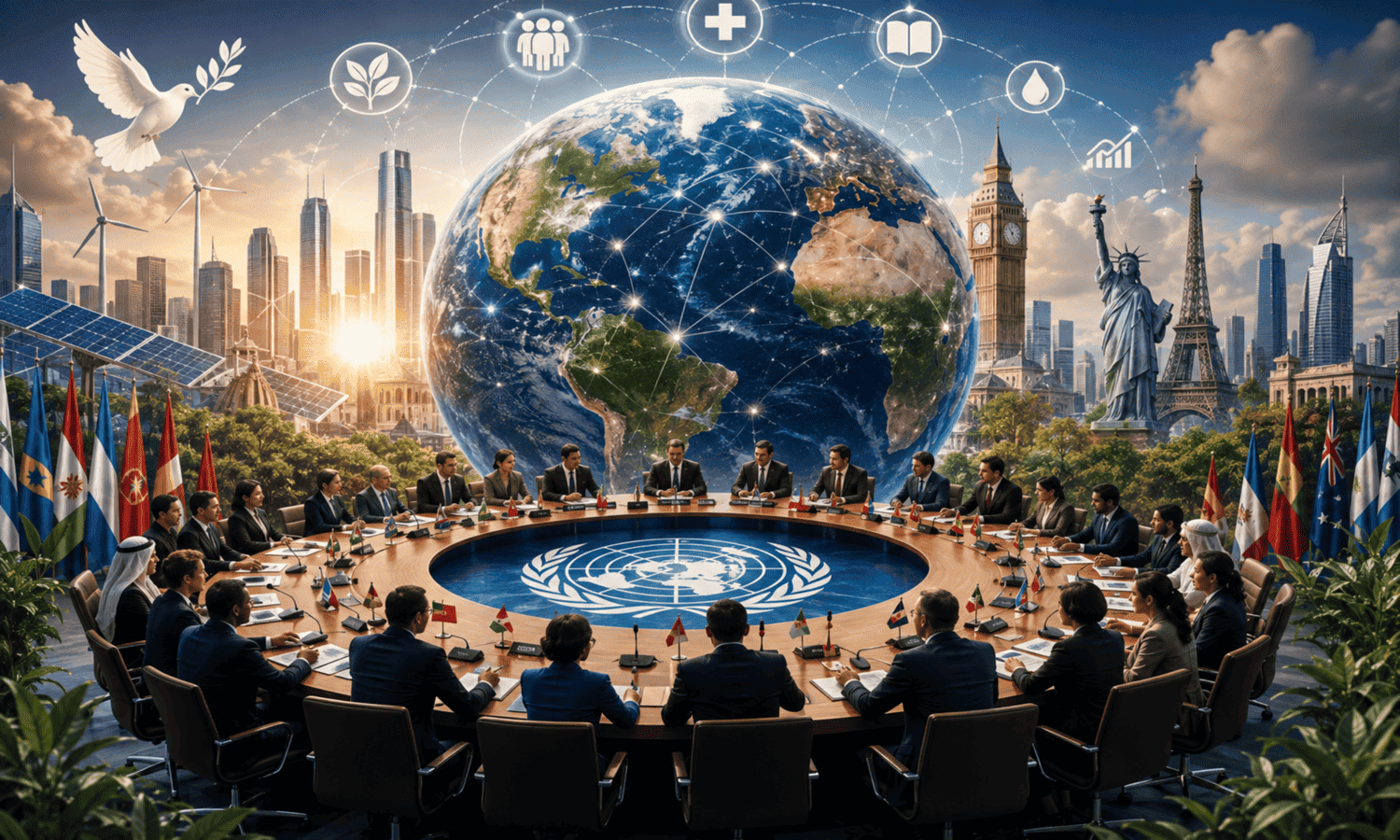
The international system is undergoing a profound transformation toward a multipolar world, in which economic, political, and technological power is increasingly distributed among a wider range of states and regional blocs. This shift creates greater opportunities for emerging powers and regional actors to influence global affairs, but it also makes international decision-making more complex and increases the risks of geopolitical rivalry, economic fragmentation, and strategic competition.
In this context, international cooperation and collective action are no longer simply matters of diplomatic preference. They have become essential to addressing challenges that transcend national borders, including climate change, global health crises, food security, migration, cybersecurity, international trade, financial stability, and the governance of emerging technologies such as artificial intelligence.
The United Nations has emphasized the importance of effective multilateralism in addressing global challenges. The Pact for the Future, adopted by UN Member States at the Summit of the Future in September 2024, calls for stronger international cooperation and reforms to make global governance more effective, inclusive, and representative of contemporary realities.
Quick Facts
- Multipolarity refers to an international system in which influence and power are distributed among several major powers, emerging powers, and regional groupings rather than being concentrated in a single dominant actor.
- The Pact for the Future was adopted by UN Member States in September 2024.
- The Pact addresses issues including sustainable development, international peace and security, technology and artificial intelligence, youth and future generations, and global governance reform.
- The World Bank has highlighted the risks associated with geopolitical and economic fragmentation, including increased restrictions on trade and investment.
What Does a Multipolar World Mean?
A multipolar world is an international system in which political, economic, military, technological, and diplomatic influence is distributed among multiple centers of power.
These centers may include major global powers, emerging economies, regional organizations, and influential international institutions. Multipolarity does not automatically produce either greater stability or greater conflict. Its consequences depend largely on how states manage competition, negotiate differences, and cooperate on shared interests.
As the number of influential actors increases, so does the need for common rules, diplomatic channels, international institutions, and mechanisms for conflict prevention and resolution.
Why Is Collective Action Becoming More Important?
1. Addressing Cross-Border Challenges
Many of today’s most serious challenges cannot be effectively addressed by individual countries acting alone.
Climate change, pandemics, cyber threats, financial instability, food insecurity, and disruptions to global supply chains all involve complex international interactions.
International cooperation allows governments to:
- Share information and scientific knowledge.
- Coordinate policies and emergency responses.
- Mobilize financial and technical resources.
- Establish common standards.
- Develop coordinated solutions to global problems.
The Pact for the Future reinforces the need for international cooperation in areas ranging from sustainable development to emerging technologies and digital governance.
2. Reducing the Risks of Economic Fragmentation
Geopolitical rivalry can increasingly affect international trade, investment, technology flows, and global supply chains. When economic relations become heavily influenced by geopolitical considerations, businesses and governments face greater uncertainty and potentially higher costs.
Effective multilateral cooperation can help :
- Preserve predictable international trade rules.
- Reduce unnecessary barriers to investment.
- Strengthen the resilience of global supply chains.
- Support developing economies.
- Reduce the economic costs of geopolitical fragmentation.
- Promote greater stability in the international economic system.
The World Bank has identified geopolitical tensions, trade restrictions, and investment barriers as significant challenges to global economic prospects, particularly for emerging and developing economies.
The Role of International Institutions in a Multipolar World
International institutions provide frameworks through which states can cooperate, negotiate, establish rules, and address shared challenges.
| Area | International Institutions and Frameworks | Main Role |
|---|---|---|
| Peace and security | United Nations and UN Security Council | Conflict prevention, diplomacy, peacekeeping, and international security |
| International trade | World Trade Organization | Trade rules and dispute settlement |
| Finance and development | World Bank and IMF | Economic stability, development financing, and financial cooperation |
| Climate change | UNFCCC and Paris Agreement | International climate cooperation |
| Global health | World Health Organization | International health coordination and emergency preparedness |
| International law | International Court of Justice and other mechanisms | Peaceful dispute settlement and respect for international law |
| Technology and AI | UN and international digital-governance frameworks | International cooperation on digital technologies and emerging risks |
These institutions do not eliminate differences between countries. Instead, they provide mechanisms for managing differences within an agreed framework.
Collective Action Does Not Require Identical Interests
One common misconception is that international cooperation requires countries to share identical political or economic interests. In reality, cooperation is often possible precisely because countries have different interests but recognize areas where collaboration benefits all sides.
Practical international cooperation can involve :
- Establishing minimum common standards.
- Maintaining continuous diplomatic communication.
- Sharing data and information.
- Developing early-warning and crisis-management mechanisms.
- Negotiating incremental agreements when comprehensive agreements are difficult.
- Improving transparency and accountability.
In this sense, multilateralism is not about eliminating differences; it is about managing differences peacefully and constructively.
Opportunities and Challenges of Multilateral Cooperation
| Opportunities | Challenges |
|---|---|
| Broader international participation | Slow decision-making |
| Greater representation of diverse interests | Conflicting interests among major powers |
| Development of common rules | Difficulties in implementation |
| Improved crisis management | Declining trust in some institutions |
| Greater international coordination | Geopolitical rivalry |
| Support for sustainable development | Financing and capacity gaps |
The challenge is therefore not simply to preserve existing institutions, but to ensure that they remain effective, legitimate, representative, and capable of responding to rapidly changing global conditions.
How Can International Institutions Be Strengthened?
1. Improving Representation and Legitimacy
Global institutions need to reflect changes in the distribution of economic and political influence.
Greater participation by developing countries in international decision-making can strengthen the legitimacy of multilateral institutions and help ensure that global policies reflect a broader range of interests.
The Pact for the Future explicitly recognizes the need to strengthen the voice and representation of developing countries in global governance and international financial institutions.
2. Increasing Effectiveness and Implementation
International agreements have limited value if they cannot be effectively implemented.
Institutions should therefore focus on :
- Clear commitments.
- Transparent decision-making.
- Effective monitoring and evaluation.
- Adequate financing.
- Institutional capacity-building.
- Better coordination between international organizations.
- Stronger accountability mechanisms.
3. Expanding Cooperation on Technology and Artificial Intelligence
Artificial intelligence and digital technologies are rapidly transforming economies, societies, security, and international relations.
Without international cooperation, differences in national regulations and standards could increase fragmentation and create new risks.
The Global Digital Compact, adopted as part of the outcomes of the 2024 Summit of the Future, represents an important step toward strengthening international cooperation on digital technologies and global digital governance.
4. Engaging Non-Governmental Actors
Governments are not the only actors capable of contributing to solutions to global challenges.
Universities, research institutions, businesses, civil society organizations, technology companies, experts, and young people can contribute valuable knowledge, innovation, and practical solutions.
A more inclusive model of global governance can therefore strengthen both the quality of policymaking and public trust in international institutions.
Key Results of Stronger International Cooperation
More effective collective action can produce several important outcomes :
- Greater international stability : through improved communication and reduced risks of miscalculation.
- A more predictable global economy : through clearer rules for trade and investment.
- Faster crisis responses : through coordinated policies and information sharing.
- More inclusive development : through greater access to financing, trade, technology, and decision-making.
- Better technology governance : through common principles and international standards.
- Greater international trust : when agreements are supported by transparency, implementation, and accountability.
The Future of International Cooperation in a Multipolar World
The emergence of a multipolar international system does not reduce the importance of international institutions. On the contrary, it makes effective multilateral cooperation even more necessary.
A world with multiple centers of power can create opportunities for broader participation and a more balanced distribution of influence. However, without effective rules and institutions, multipolarity can also contribute to geopolitical rivalry, economic fragmentation, and weakened international cooperation.
The central challenge is therefore not to choose between competition and cooperation, but to manage competition through dialogue, common rules, diplomacy, and credible institutions.
The adoption of the Pact for the Future in 2024 reflects growing recognition of the need to modernize multilateralism and strengthen global governance so that international institutions can respond more effectively to contemporary and emerging challenges.
Conclusion
In an increasingly interconnected world, collective action and international institutions are essential components of a stable and effective multipolar international system.
The success of global cooperation will depend on the ability of states and institutions to strike a balance between national sovereignty and shared interests, competition and cooperation, and diverse centers of power and common international rules.
A multipolar world does not have to become a fragmented world. With effective diplomacy, credible institutions, inclusive decision-making, and stronger international cooperation, multipolarity can become an opportunity to build a more representative, resilient, and sustainable international order.
Leave a Reply