
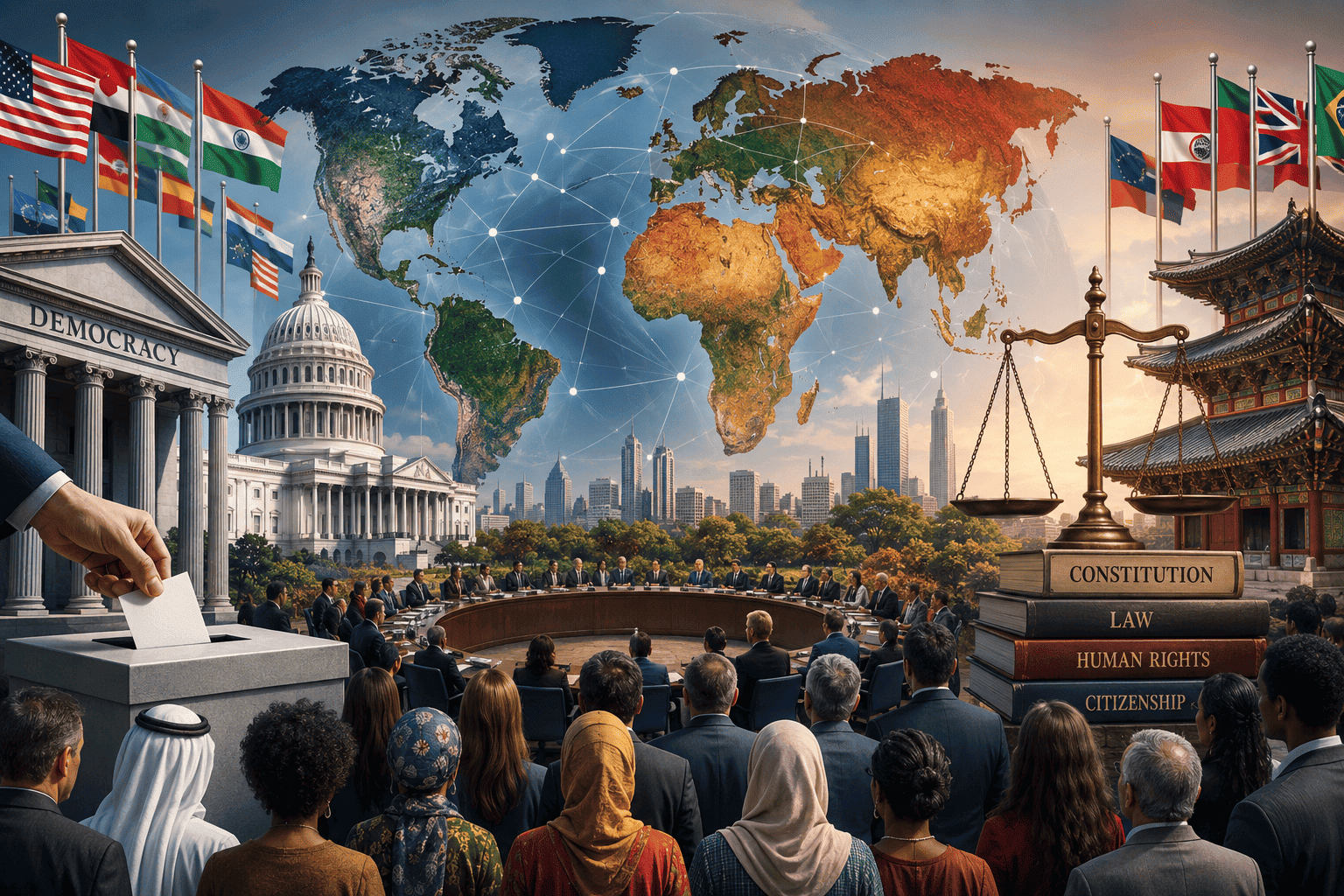
Political arrangements shape far more than the way governments function. They influence national identity, cultural expression, social values, economic priorities, and relations between communities and states. From federal democracies and constitutional monarchies to centralized states and hybrid political systems, the structures through which societies organize power can reveal important patterns in world culture.
Understanding these arrangements requires more than comparing political institutions. It also means examining history, geography, religion, language, colonial legacies, economic conditions, and social movements. Political systems evolve within particular cultural settings, and culture, in turn, can influence how political institutions operate.
Quick Facts
- Political arrangements describe how political authority is organized, distributed, and exercised.
- Common forms include democratic republics, constitutional monarchies, federal systems, unitary states, and authoritarian systems.
- Political institutions do not exist in isolation; they are shaped by history, culture, geography, and economic development.
- Countries with similar constitutional structures can have very different political cultures and outcomes.
- Globalization, migration, digital communication, and international organizations increasingly connect domestic politics with global cultural change.
What Are Political Arrangements?
A political arrangement is the framework through which a society creates, distributes, and limits political power. It includes formal institutions such as constitutions, legislatures, courts, executives, and electoral systems, as well as informal practices, traditions, and social expectations.
Several major features help distinguish political systems:
- Distribution of power : Authority may be concentrated in a central government or divided among national, regional, and local institutions.
- Leadership selection : Leaders may be elected, appointed, inherited, or selected through restricted political processes.
- Political participation : Citizens may participate through competitive elections, political parties, civil society, protests, or other forms of public engagement.
- Rule of law : The relationship between government authority and legal institutions varies significantly across countries.
- Protection of rights : Constitutions and laws can establish different levels of protection for political, civil, and social rights.
These characteristics provide a useful framework for comparing political arrangements without assuming that one institutional model automatically produces the same results everywhere.
Major Political Arrangements Around the World
Democratic Republics
In a democratic republic, political authority is exercised through institutions in which citizens generally choose representatives through elections. Constitutional rules commonly define government powers and establish mechanisms for accountability.
However, democratic republics vary widely. Some have strong presidential systems, while others rely on parliamentary government. Electoral rules, party systems, judicial independence, and media environments can also produce very different political cultures.
Constitutional Monarchies
A constitutional monarchy combines a hereditary monarch with constitutional government. In many such systems, elected institutions and governments exercise most day-to-day political authority, while the monarch has largely ceremonial or limited constitutional responsibilities.
The cultural meaning of monarchy also varies. In some societies, the institution is closely associated with national history and identity; elsewhere, it plays a much smaller symbolic role.
Federal Systems
A federal political system divides authority between a national government and territorial units such as states, provinces, or regions.
Federalism can help accommodate regional diversity, linguistic differences, ethnic communities, and distinct local political traditions. At the same time, disputes over taxation, education, natural resources, or political authority can create tensions between central and regional governments.
Unitary States
In a unitary system, the central government holds primary constitutional authority, although substantial powers may be delegated to local or regional administrations.
Unitary government does not necessarily mean that every decision is made centrally. Many unitary states have extensive local government structures. The key distinction is that regional authority generally derives from the national constitutional framework rather than possessing constitutionally entrenched sovereignty comparable to federal units.
Authoritarian and Hybrid Systems
In authoritarian systems, political power is concentrated and political competition or public participation is significantly restricted. Some systems are highly centralized, while others maintain formal elections and institutions without providing the same level of political competition found in liberal democracies.
Hybrid systems combine features associated with competitive politics and authoritarian governance. Their institutions may include elections, legislatures, and political parties while political freedoms, institutional checks, or electoral competition remain limited.
Political Arrangements and World Culture
Political institutions both reflect and influence culture. Yet the relationship is complex.
A society’s political traditions can be influenced by religious beliefs, historical conflicts, colonial experiences, economic structures, migration, language, and ideas about authority. At the same time, governments can shape cultural life through education policy, language laws, citizenship rules, media regulation, and cultural institutions.
For example, decisions about which languages receive official recognition can affect education, public administration, and cultural identity. Likewise, citizenship policies can influence how societies define national belonging.
This interaction means that political geography cannot be separated completely from cultural geography.
Key Research Findings
Research in comparative politics and political science points to several broad conclusions:
- Institutions matter, but context matters too. The same constitutional structure can function differently depending on political traditions, institutions, economic conditions, and social relationships.
- Political stability is influenced by institutional legitimacy. Governments tend to face fewer challenges when citizens regard political institutions as legitimate and responsive.
- Power-sharing can be important in divided societies. Federalism, coalition governments, decentralization, and other mechanisms can sometimes help manage regional or communal differences.
- Political participation extends beyond elections. Civil society organizations, journalism, protests, community groups, and digital platforms can all influence political life.
- Historical legacies remain significant. Colonial borders, past conflicts, state-building processes, and constitutional traditions continue to influence contemporary political arrangements.
These findings caution against treating political systems as simple formulas. Institutional design interacts with social and historical conditions.
Main Results or Causes
Several factors help explain why political arrangements differ across the world.
1. Historical Experience
Wars, revolutions, independence movements, and state-building processes often leave lasting institutional legacies. Countries may retain political practices developed during earlier periods even after major constitutional reforms.
2. Geography
Large territories, mountainous regions, remote communities, and geographically concentrated populations can influence decisions about centralization and decentralization.
3. Cultural and Linguistic Diversity
Where populations contain multiple linguistic, ethnic, or cultural communities, political institutions may develop mechanisms for representation and regional autonomy.
4. Economic Conditions
Economic structures can influence relationships between governments, businesses, workers, and citizens. Resource-rich economies, agricultural societies, industrial economies, and service-based economies may face different political pressures.
5. Colonial Legacies
Colonial administration shaped borders, legal systems, bureaucratic structures, and political institutions in many parts of the world. The consequences remain visible in numerous contemporary states.
6. International Institutions
Organizations such as the United Nations, regional political unions, development institutions, and international courts can influence domestic policy while creating new forms of cooperation and accountability.
Comparing Political Arrangements
| Political arrangement | Distribution of power | Leadership | Cultural significance |
|---|---|---|---|
| Democratic republic | Usually dispersed through elected institutions | Generally elected | Often emphasizes citizenship and representative government |
| Constitutional monarchy | Shared between elected institutions and a monarch with constitutionally defined powers | Government typically formed through elected institutions | May connect modern politics with historical identity |
| Federal system | Divided between national and regional governments | Varies | Can accommodate regional and cultural diversity |
| Unitary system | Primarily concentrated at the national level, with delegated local powers | Varies | Often emphasizes national institutional coherence |
| Authoritarian system | More concentrated among a leader, party, military, or ruling elite | Often restricted or controlled | Political culture may emphasize order, continuity, or loyalty |
| Hybrid system | Combines competitive and restrictive features | Elections may exist alongside significant constraints | Political participation and institutional legitimacy can be contested |
Political Arrangements in a Globalized World
The relationship between politics and culture is becoming increasingly interconnected. Migration, social media, international trade, transnational activism, and digital communication allow political ideas to move rapidly across borders.
Citizens can now observe elections, protests, constitutional debates, and social movements in other countries almost instantly. This creates opportunities for learning and cooperation, but it can also accelerate political polarization and the spread of misinformation.
International migration adds another dimension. People often maintain cultural and political connections with more than one country, challenging traditional assumptions about national identity.
As a result, political arrangements increasingly operate within both domestic and global cultural environments.
Why Mapping Political Culture Matters
Mapping political arrangements is valuable because political institutions provide clues about how societies understand authority, citizenship, representation, identity, and collective decision-making.
However, political maps should not be interpreted as cultural stereotypes. Countries contain diverse communities, competing political traditions, and changing social attitudes. A constitutional label alone cannot fully describe how power works in practice.
A meaningful analysis therefore combines :
- Political institutions
- Historical context
- Cultural diversity
- Economic conditions
- Public attitudes
- Civil society
- International relationships
This broader approach provides a more accurate picture of the relationship between political organization and world culture.
Conclusion
Political arrangements are a central part of the map of world culture. They determine how authority is organized, but they are also products of the histories, identities, conflicts, and social structures of the societies in which they operate.
Democracies, monarchies, federal systems, unitary states, authoritarian governments, and hybrid regimes demonstrate that there is no single political model capable of explaining every society. Their institutions develop through distinctive historical and cultural circumstances.
The most useful way to understand global political culture is therefore not to rank systems mechanically, but to examine how institutions interact with history, identity, geography, economics, and public participation. By doing so, political geography becomes more than a study of governments: it becomes a way to understand how societies organize power and express their collective identities.
Leave a Reply