
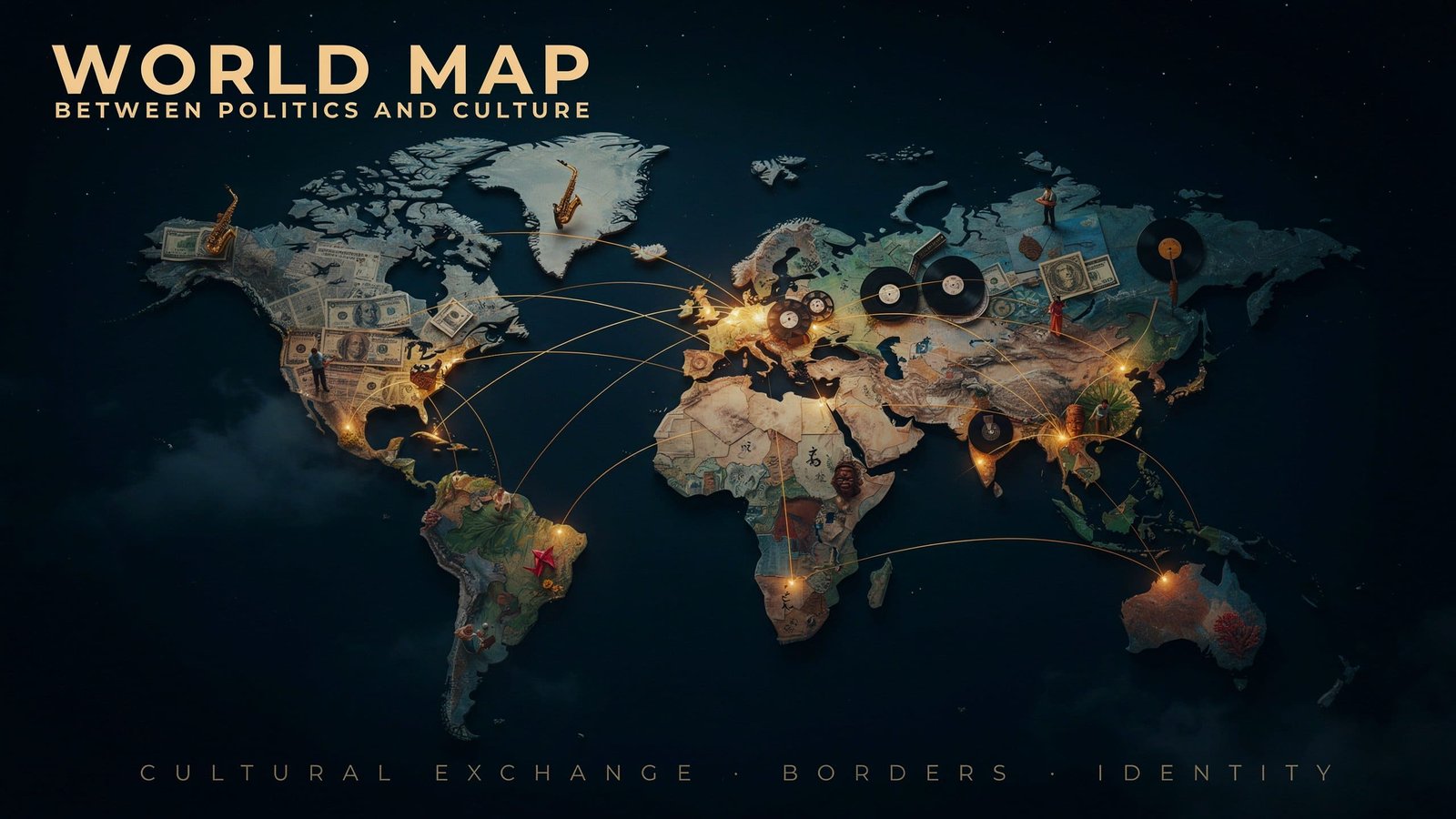
Political change is no longer confined to elections, parliaments, and diplomatic summits. Across borders, geopolitical realignments, migration, digital technology, cultural policy, and rising political polarization are reshaping how societies understand identity and influence.
The result is a changing map of global culture—one in which cultural power is increasingly distributed across regions rather than concentrated in a small group of traditional Western centers. Music, film, literature, fashion, food, language, and digital communities now move across borders at extraordinary speed, while governments are becoming more active in deciding which cultural narratives receive support, protection, or global visibility.
This transformation does not mean that globalization is ending. Instead, it suggests that global culture is becoming more plural, contested, and politically significant.
Quick Facts
- The International Organization for Migration estimates that 281 million people were international migrants, equivalent to about 3.6% of the world’s population, in its 2024 report.
- UNESCO’s first Global Report on Cultural Policies draws on more than 1,200 national and local reports submitted between 2019 and 2024.
- UNESCO reports that cultural and creative industries generate about 3.39% of global GDP and account for an average of 3.55% of jobs.
- Migration, urbanization, and digital technology are bringing cultures into closer contact while also creating new challenges involving social cohesion, exclusion, and hate speech.
- Political instability, conflict, and forced displacement are increasingly affecting artists, cultural professionals, and cultural expression.
Key Research Findings
Research from international organizations points to several broad trends.
1. Migration Is Changing Cultural Landscapes
Migration is one of the most visible forces reshaping contemporary culture. People carry languages, religious traditions, food, music, artistic practices, and social customs with them, creating cultural exchanges that extend well beyond national borders.
According to the IOM, international migration has increased substantially since the beginning of the 21st century. The estimated number of international migrants rose from 150 million in 2000 to 281 million in the 2024 report.
However, migration should not be treated as a one-way process in which cultures simply move from one country to another. Cities and communities transform migrants’ cultural practices just as migrants influence their new environments.
The result is often a hybrid cultural landscape: neighborhoods, restaurants, music scenes, schools, workplaces, and online communities where multiple traditions interact.
2. Political Power Increasingly Shapes Cultural Policy
Governments have long used cultural policy to strengthen national identity. Today, that role is becoming more visible as countries respond to geopolitical competition, social polarization, and rapid technological change.
UNESCO’s global review of cultural policies identifies digital transformation, cultural rights, arts education, sustainability, and resilience as major policy concerns. It also finds that 93% of reporting countries recognize culture as important within national sustainable-development plans.
Political decisions can therefore influence :
- Which languages receive institutional support
- How national history is taught
- Public funding for museums and the arts
- Protection of cultural heritage
- Rules governing media and online platforms
- Support for minority and indigenous cultures
- The international promotion of national creative industries
This makes culture more than a matter of entertainment or heritage. Cultural policy has become part of the broader struggle over identity, influence, and national priorities.
How Geopolitical Change Is Reshaping Global Culture
The global cultural system is increasingly influenced by a combination of political, economic, and technological forces.
| Political or social shift | Cultural impact |
|---|---|
| Migration and mobility | Greater linguistic, religious, and artistic diversity |
| Geopolitical competition | More emphasis on national narratives and cultural influence |
| Digital transformation | Faster international circulation of music, film, ideas, and trends |
| Conflict and displacement | Greater pressure on cultural heritage and artistic communities |
| Cultural policy reforms | Changing levels of public support for arts and cultural institutions |
| Economic realignment | Greater visibility for creative industries outside traditional cultural centers |
These developments do not operate independently. A political crisis can trigger migration; migration can reshape urban culture; digital platforms can amplify new cultural voices; and governments can then respond with new policies concerning identity and social cohesion.
The Rise of a More Multipolar Cultural World
For much of the modern era, global cultural influence was strongly associated with a relatively small number of powerful countries and media industries. That hierarchy has become harder to sustain.
Today, audiences can discover music, cinema, television, literature, fashion, cuisine, and online creators from almost anywhere. Cultural influence increasingly travels in multiple directions.
This is visible in the growing international reach of creative industries from Asia, Africa, Latin America, the Middle East, and other regions. Digital distribution has reduced some of the traditional barriers between producers and international audiences.
But digital access does not automatically create cultural equality. UNESCO warns that artists and cultural professionals continue to face challenges including censorship, online harassment, political instability, and inadequate protection.
The emerging cultural map is therefore more diverse but not necessarily more equal.
Digital Platforms Are Changing Who Controls Cultural Influence
Social media and streaming services have dramatically altered the relationship between culture and geography.
A song recorded in one country can become popular thousands of miles away without passing through traditional broadcasters. A filmmaker can find an international audience through a digital platform. A local fashion trend can become a global phenomenon within weeks.
This creates new opportunities for cultural exchange, but it also creates new political questions.
Who controls the platforms? Who determines what becomes visible? Which languages are well represented in digital spaces? And how do algorithms influence cultural discovery?
UNESCO’s work on cultural policy identifies digital technologies as both an opportunity for innovation and a source of new inequalities.
The politics of culture is therefore moving partly online. Digital infrastructure has become part of cultural power.
Conflict, Displacement, and the Protection of Culture
Political instability can reshape culture in more destructive ways.
War and forced displacement can separate artists from their communities, threaten historic sites, disrupt cultural institutions, and place languages and traditions under severe pressure. UNESCO notes that political instability, conflict, and forced displacement increase risks for artists and cultural professionals.
At the same time, culture can become a tool of resilience. Diaspora communities often preserve language, music, cuisine, religious practices, and collective memory after displacement.
This creates a paradox : political upheaval can damage cultural ecosystems while simultaneously strengthening people’s determination to preserve cultural identity.
Main Results or Causes
Several major forces explain why political shifts are redrawing the global cultural map :
- Changing migration patterns
Human mobility is creating increasingly diverse communities and expanding cultural exchange across borders. - Geopolitical competition
Countries are placing greater emphasis on national identity, cultural diplomacy, and international influence. - Digital globalization
Online platforms allow cultural products and ideas to travel rapidly, reducing the importance of traditional geographic boundaries. - Political polarization
Debates over immigration, religion, national identity, gender, language, and historical memory increasingly influence cultural policy. - Economic transformation
Cultural and creative industries have become economically significant, giving governments additional reasons to invest in—or regulate—them. UNESCO estimates that these industries generate 3.39% of global GDP. - Conflict and displacement
Wars, political crises, and humanitarian emergencies can disrupt cultural institutions while producing new diaspora cultures. - Greater recognition of cultural diversity
International cultural policy is increasingly concerned with participation, cultural rights, inclusion, and the protection of artistic expression.
What the New Cultural Map Means
The emerging global cultural order should not be understood simply as a contest between “Western” and “non-Western” cultures. That framework is too narrow for today’s interconnected world.
Instead, cultural influence increasingly comes from networks of people, cities, communities, creators, platforms, and institutions.
A migrant neighborhood can become a cultural hub. A small music scene can reach an international audience. A regional film industry can develop a global following. A diaspora can preserve traditions while adapting them to a new environment.
At the same time, governments can accelerate or restrict these processes through immigration rules, cultural funding, education policies, media regulation, and digital legislation.
The central question is therefore not whether politics influences culture. It clearly does. The more important question is how political decisions will shape the conditions under which different cultures can participate in the global conversation.
Conclusion
Political shifts are redrawing the map of global culture, but the transformation is more complicated than a simple transfer of cultural power from one region to another.
Migration is creating more diverse societies. Digital platforms are expanding access to cultural expression. Geopolitical competition is encouraging governments to invest more heavily in national identity and cultural influence. Meanwhile, conflict and political instability continue to threaten artists, cultural institutions, and heritage.
The evidence suggests that globalization is not disappearing. It is being reconfigured.
The cultural landscape of the future is likely to be more multipolar, digitally connected, and diverse—but also more politically contested. Countries and communities that protect cultural participation, artistic freedom, pluralism, and meaningful cultural exchange will be better positioned to benefit from that diversity.
Ultimately, the new global cultural map will not be drawn by governments alone. It will also be shaped by migrants, artists, audiences, entrepreneurs, digital communities, and ordinary citizens whose cultural choices increasingly cross national borders.
Leave a Reply