
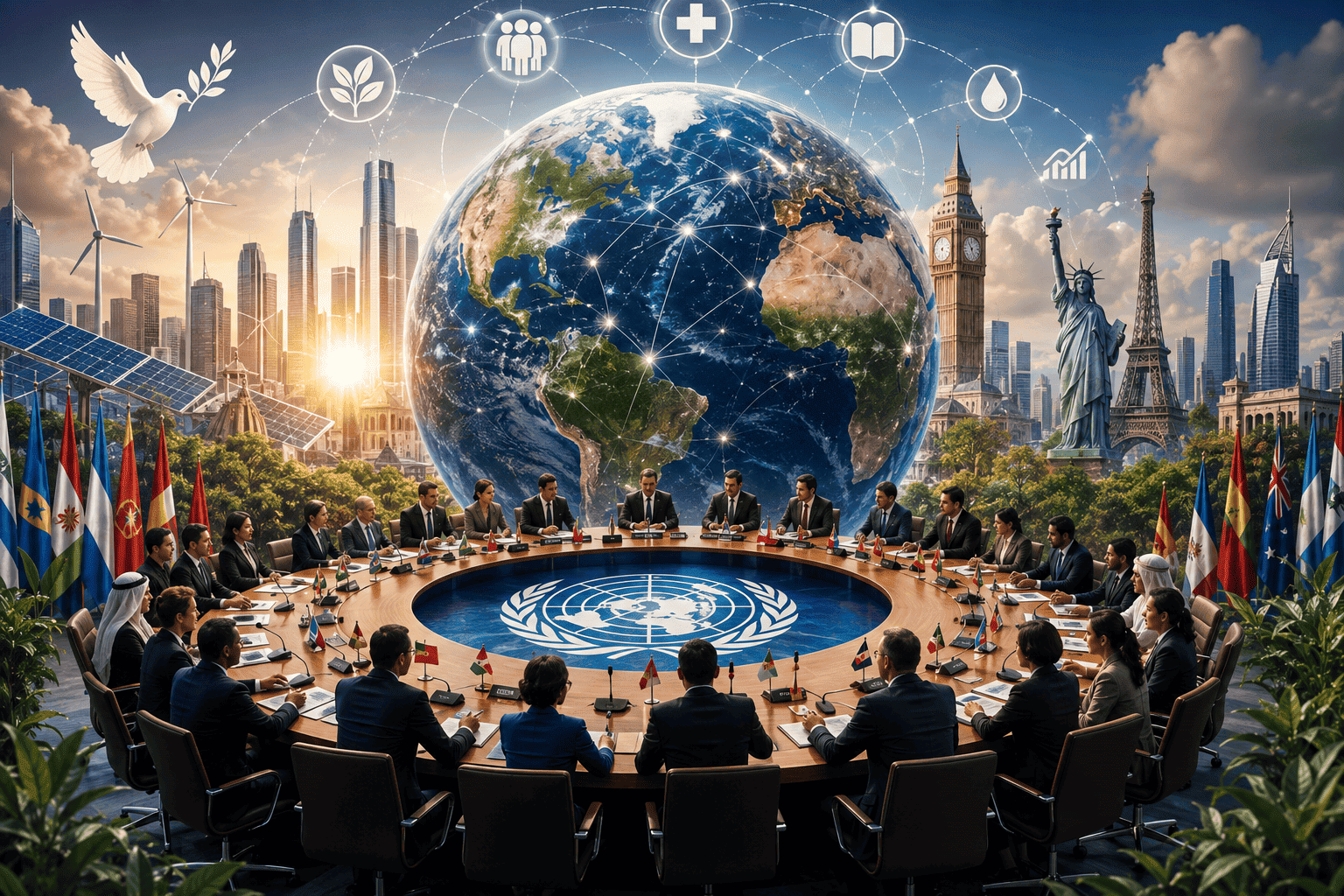
How can political balance, diplomacy, and international cooperation reduce the risks of an arms race? An evidence-based look at the role of international law and multilateral institutions in promoting global peace and security.
In a world facing growing geopolitical tensions and accelerating military spending, international security is no longer an issue that concerns individual countries alone. It has become a shared responsibility requiring broad political and diplomatic cooperation. As the gap between the logic of force and the logic of dialogue widens, the risks of miscalculation and escalation also increase.
According to the latest data from the Stockholm International Peace Research Institute (SIPRI), global military expenditure reached approximately $2.887 trillion in 2025, representing a real increase of 2.9% compared with 2024 and marking the eleventh consecutive year of rising global military spending.
These figures do not necessarily mean that increased military spending inevitably leads to war. They do, however, demonstrate the scale of resources devoted to military security at a time when societies also need investment in development, justice, and long-term stability.
What Does Political Balance Mean?
Political balance does not mean that all countries must possess equal military power, nor does it mean imposing a single settlement on all parties. Rather, it refers to creating an international environment in which states can protect their interests through dialogue, alliances, international law, mediation, deterrence mechanisms, and multilateral institutions, rather than relying on military force alone.
This approach is based on a fundamental principle of the United Nations Charter: international disputes should be settled through peaceful means, and states should refrain from the threat or use of force in ways inconsistent with the purposes of the United Nations.
Political balance can therefore function as an institutional “shield.” It does not eliminate disagreements between states, but it seeks to prevent those disagreements from turning into open conflict.
Why Has Political Balance Become More Important?
1. Rising Global Military Expenditure
SIPRI data show that global military expenditure reached a record $2.887 trillion in 2025, with the global military burden reaching approximately 2.5% of worldwide GDP. Military spending increased by 14% in Europe and 8.1% in Asia and Oceania during the same year.
These figures should not be interpreted as standalone evidence that a global war is imminent. They are, however, a clear indicator of continuing security concerns and strategic tensions in different parts of the world.
2. Preventing Political Miscalculation
During international crises, the problem is not always the intentions of the parties involved. Sometimes it is a misunderstanding of the other side’s intentions.
For this reason, diplomatic communication channels, mediation, military transparency agreements, and mechanisms for preventing escalation can all help reduce the possibility that a limited crisis will develop into a broader confrontation.
3. Protecting Civilians
Security should not be measured solely by a state’s ability to defend its borders. It should also be measured by its ability to protect civilians from the consequences of conflict.
International humanitarian law establishes fundamental principles governing the conduct of hostilities, including distinguishing between civilians and combatants, proportionality, and taking feasible precautions to minimize harm to civilians.
Any discussion of security and weapons should therefore place human beings at its center rather than defining security solely by the size of a country’s military arsenal.
From an Arms Race to a Race for Cooperation
Reducing the risks of conflict does not necessarily require eliminating national armed forces or ignoring legitimate security concerns. Instead, it requires moving from a concept of security that relies excessively on expanding military capabilities toward a broader approach based on multiple tools.
Among the most important are :
- Preventive diplomacy to address crises before they develop into conflicts.
- Multilateral dialogue to create areas of understanding between competing states.
- Arms-control and disarmament agreements when appropriate political conditions exist.
- Greater transparency to reduce the risks of misunderstanding and miscalculation.
- International mediation in conflicts where direct negotiations between the parties are difficult.
- Strengthening international and regional institutions capable of managing crises.
- Investment in development, justice, and the rule of law as essential foundations for long-term stability.
Can Military Power Alone Deliver Security?
Military power can play an important role in deterrence and defense. However, making it the primary instrument for managing international relations carries significant risks.
Growing military expenditure can be a response to existing tensions, but it can also contribute to a security dilemma. One state may consider expanding its defensive capabilities necessary for its security, while another may perceive the same measures as a threat and respond by increasing its own capabilities. The cycle can then continue.
Sustainable security therefore requires a balance between deterrence, diplomacy, and international law.
The issue is not about choosing absolutely between military power and politics. Rather, it is about building a system in which the use of force becomes a last resort and political and legal mechanisms have a genuine opportunity to succeed.
The United Nations and International Cooperation : From Principle to Practice
The United Nations Charter places the peaceful settlement of disputes at the heart of the international system. It also emphasizes the obligation to refrain from the use of force against the territorial integrity or political independence of states, alongside other provisions concerning collective security.
However, having rules is not enough.
The effectiveness of the international system also depends on states’ willingness to comply with those rules, the ability of international institutions to function effectively, and the existence of political will to pursue negotiated solutions when crises emerge.
This is where multilateralism becomes particularly important. States may have competing interests, but they can still agree on common rules that reduce the risks of conflict and disorder.
Peace Is More Than the Absence of War
Sustainable peace is also connected to effective institutions, the rule of law, justice, and inclusive governance.
United Nations Sustainable Development Goal 16 emphasizes the importance of building peaceful and inclusive societies, providing access to justice, and developing effective, accountable, and inclusive institutions at all levels.
This broadens the concept of security from protecting borders to addressing conditions that can contribute to instability, including weak institutions, lack of justice, political exclusion, and a lack of trust.
What Can Create a More Sustainable Political Balance?
The most important elements can be summarized in five key areas :
| Area | Objective |
|---|---|
| Diplomacy | Keeping channels of dialogue open during crises |
| International Law | Establishing common rules for managing disputes |
| Arms Control | Reducing the risks of arms races and escalation |
| International Institutions | Providing mechanisms for mediation, coordination, and collective action |
| Development and Justice | Addressing the roots of instability over the long term |
These elements do not provide an immediate solution to every conflict, but they create a framework better equipped to prevent crises from developing into large-scale confrontations.
The World Unites Us : Security Is a Shared Responsibility
Ultimately, sustainable global security cannot be built on the assumption that one country’s security must come at the expense of another country’s security. In an economically, technologically, and environmentally interconnected world, the consequences of wars and crises can cross national borders rapidly.
For this reason, political balance does not mean abandoning national interests. It means finding ways to manage those interests without turning differences into confrontation.
Investing in diplomacy, dialogue, and international law is not an alternative to security; it can be one of its most important foundations. At the same time, respect for international humanitarian law and the protection of civilians remain essential, particularly when efforts to prevent conflict fail.
Conclusion : Political Balance as the First Line of Defense
Recent trends in military spending demonstrate that the world is facing an increasingly complex security environment. Yet military expansion alone cannot be considered a measure of security or peace.
True security requires a balance between deterrence and dialogue, between national interests and international obligations, and between military power and political institutions.
As geopolitical tensions continue, diplomacy, international cooperation, and arms-control efforts become essential tools for building stability.
Summary :
Political balance and global peace are among the most important approaches to reducing the risks associated with arms races and international escalation. Through diplomacy, international law, multilateral cooperation, arms control, and stronger institutions, states can help build a more stable security system that protects national interests while placing civilian protection and sustainable peace at its core.
Leave a Reply