
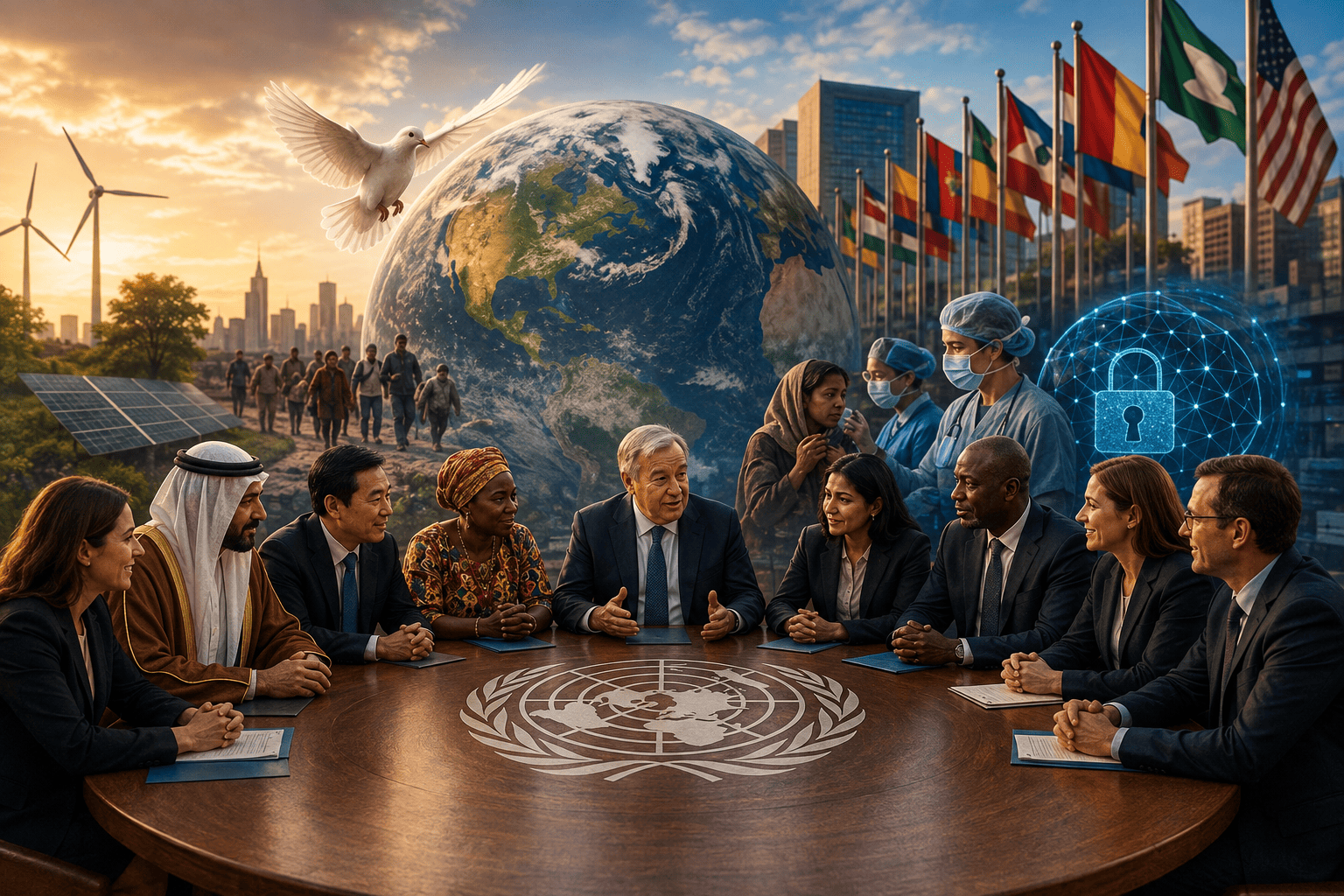
In an increasingly interconnected world, no country can address the most serious global challenges alone. Climate change, armed conflict, pandemics, cyber threats, economic instability, migration, and artificial intelligence cross borders with little regard for national boundaries. As these challenges grow more complex, international diplomacy and multilateral cooperation have become essential tools for protecting peace, security, and sustainable development.
Diplomacy is no longer limited to negotiations between governments. Today, it also involves international organizations, scientists, businesses, civil society, humanitarian groups, and communities. The central question is no longer whether countries should cooperate, but how effectively they can work together while protecting their national interests.
Quick Facts
- Global challenges are interconnected : Climate shocks can contribute to food insecurity, displacement, and political instability.
- Diplomacy remains a primary instrument of conflict prevention : Dialogue can create channels for negotiation even when relations between states are strained.
- Multilateral institutions provide a framework for cooperation : Organizations such as the United Nations, World Health Organization, and World Trade Organization help countries coordinate responses to shared problems.
- Technology is reshaping international relations : Artificial intelligence, cyber capabilities, and digital communications are creating new opportunities as well as security risks.
- Trust is a strategic resource : International agreements are more effective when governments can verify commitments and hold one another accountable.
Why Diplomacy Matters in the 21st Century
The traditional concept of diplomacy focused largely on relations between sovereign states. Modern diplomacy is broader because modern risks are broader.
A virus can spread across continents within weeks. Carbon emissions produced in one region can influence weather patterns elsewhere. A cyberattack can affect infrastructure thousands of kilometres from its origin. Financial instability can move rapidly through interconnected markets.
These realities make international cooperation not simply an ideal but a practical necessity.
Effective diplomacy can help countries :
- Prevent and resolve conflicts through negotiation and mediation.
- Coordinate responses to global crises, including pandemics and natural disasters.
- Protect international trade and economic stability through shared rules.
- Address climate change through collective commitments and financing.
- Establish rules for emerging technologies, particularly artificial intelligence and cyber systems.
- Strengthen humanitarian cooperation during wars, displacement crises, and disasters.
Diplomacy does not eliminate disagreement. Its purpose is to create mechanisms through which disagreement can be managed without allowing every dispute to become a crisis.
The Major Challenges Requiring Global Cooperation
1. Climate Change and Environmental Security
Climate change is one of the clearest examples of a challenge that cannot be solved by individual countries acting alone.
Extreme heat, droughts, floods, rising sea levels, and biodiversity loss can damage economies and intensify pressure on food, water, and other resources. Vulnerable communities often face the greatest consequences despite having contributed relatively little to historical greenhouse-gas emissions.
International diplomacy therefore has to address several issues at once :
- Reducing greenhouse-gas emissions.
- Expanding renewable and low-carbon energy.
- Financing climate adaptation.
- Protecting forests, oceans, and biodiversity.
- Supporting countries facing severe climate-related losses and damage.
The challenge is political as much as environmental. Countries have different economic structures, development priorities, energy needs, and levels of responsibility for past emissions. Successful climate diplomacy depends on finding agreements that are ambitious, realistic, and fair.
2. War, Peace, and Human Security
Armed conflicts remain among the greatest threats to human security. Beyond battlefield casualties, wars can destroy infrastructure, disrupt food supplies, drive displacement, damage economies, and create long-term political instability.
Diplomacy cannot prevent every war, but it can provide opportunities for de-escalation, ceasefire negotiations, humanitarian access, mediation, and eventually political settlements.
Modern peacebuilding increasingly recognizes that lasting peace requires more than ending violence. It may also involve :
- Rebuilding institutions.
- Protecting civilians.
- Supporting displaced populations.
- Addressing the causes of conflict.
- Strengthening the rule of law.
- Creating economic opportunities for affected communities.
The lesson is clear: peace is not merely the absence of war; it is the presence of institutions and conditions that make peaceful coexistence possible.
3. Global Health and Pandemic Preparedness
The COVID-19 pandemic demonstrated how quickly a health emergency can become an economic and social crisis. It also highlighted the importance of international information-sharing, medical research, supply chains, vaccination systems, and emergency preparedness.
Future pandemic preparedness will depend on cooperation in areas such as :
- Disease surveillance.
- Scientific research.
- Early warning systems.
- Medical supply chains.
- Health-system capacity.
- Transparent communication.
- Equitable access to essential medical technologies.
Global health security is inseparable from international cooperation. A disease outbreak does not stop at a national border, and neither should efforts to contain it.
4. Artificial Intelligence and Digital Security
The rapid development of artificial intelligence is creating a new frontier for diplomacy. AI can contribute to scientific discovery, economic growth, healthcare, education, and public services. At the same time, it raises concerns about misinformation, privacy, cyber operations, autonomous weapons, employment, and the concentration of technological power.
Governments face a difficult balancing act: encourage innovation while establishing safeguards against serious harm.
International dialogue can help develop common principles for :
- Responsible AI development.
- Transparency and accountability.
- Cybersecurity.
- Protection of personal data.
- Human oversight of high-risk systems.
- Research and technology cooperation.
Because digital technologies operate across borders, international rules for responsible technology governance will increasingly influence global security.
Key Research Findings
Research and assessments from major international institutions point to several recurring conclusions:
- Interdependence is increasing. Economic, environmental, technological, and security risks increasingly affect one another.
- Prevention is generally less costly than crisis response. Early diplomacy, preparedness, and investment can reduce the human and financial consequences of major crises.
- International institutions remain important but face pressure to adapt. Global organizations must respond to changing power structures, technological developments, and emerging threats.
- Trust and transparency improve cooperation. Countries are more likely to uphold agreements when commitments can be monitored and verified.
- Inclusive cooperation produces stronger outcomes. Global solutions are more legitimate and durable when developing countries and affected communities have a meaningful voice.
These findings reinforce an important principle : international cooperation is most effective when it combines shared responsibility with credible institutions and practical implementation.
The Main Results and Causes Behind Global Cooperation
What Drives Countries to Cooperate?
Countries cooperate internationally for several interconnected reasons :
Shared interests: Governments often discover that cooperation produces benefits that cannot be achieved independently.
Economic interdependence: International trade, investment, energy markets, and supply chains create strong incentives for stability.
Common threats : Climate change, pandemics, terrorism, cybercrime, and transnational organized crime can affect countries regardless of political boundaries.
Diplomatic pressure : International organizations, allies, and public opinion can encourage governments to negotiate.
Mutual dependence : In many areas, countries need one another’s technology, resources, expertise, markets, or financial support.
What Prevents Cooperation?
Cooperation can also be undermined by :
- Competing national interests.
- Geopolitical rivalry.
- Distrust between governments.
- Unequal economic resources.
- Weak enforcement mechanisms.
- Domestic political pressures.
- Disagreements over responsibility and burden-sharing.
Understanding these obstacles is essential. Diplomacy succeeds not because differences disappear, but because negotiators find ways to manage those differences.
Multilateralism vs. Bilateral Diplomacy
| Approach | Main Strength | Main Challenge |
|---|---|---|
| Bilateral diplomacy | Allows two countries to focus directly on specific interests | May not address problems involving many countries |
| Multilateral diplomacy | Creates shared rules and broader participation | Negotiations can be slower and more difficult |
| Regional cooperation | Addresses challenges among geographically connected countries | Regional interests may not align with global priorities |
| Track-two diplomacy | Allows experts, academics, and civil society to support dialogue | Outcomes may lack formal government authority |
The strongest international responses often combine these approaches rather than relying on one model.
A New Generation of Diplomacy
The diplomacy of the 21st century must be more flexible, inclusive, evidence-based, and technologically aware.
Governments remain central actors, but they are no longer the only participants. Scientists can help establish facts. Humanitarian organizations can provide expertise from conflict zones. Businesses can influence technology and investment. Civil society can highlight the experiences of affected communities.
This broader diplomatic ecosystem can make negotiations more informed and practical.
At the same time, diplomacy must retain its human dimension. Behind every statistic are people whose lives are affected by decisions made in conference rooms and international institutions.
How the World Can Strengthen International Cooperation
A more effective system of global cooperation requires several priorities :
- Invest in preventive diplomacy. Detecting tensions early can reduce the likelihood of escalation.
- Strengthen international institutions. Global organizations need sufficient resources, legitimacy, and capacity to respond effectively.
- Improve transparency. Reliable information and verification mechanisms can reduce mistrust.
- Give developing countries a stronger voice. International decision-making is more credible when it reflects the diversity of the global community.
- Connect diplomacy with science. Policymakers need independent scientific evidence when addressing climate, health, technology, and environmental risks.
- Protect international law. Rules are meaningful only when countries are prepared to respect and uphold them.
- Build public trust. Citizens are more likely to support international cooperation when its benefits and responsibilities are clearly explained.
Conclusion
The defining challenges of the 21st century do not respect borders. Climate change, conflict, pandemics, technological disruption, economic instability, and humanitarian crises demonstrate how closely connected the world’s future has become.
Diplomacy cannot solve every problem, and international cooperation will always involve disagreement and compromise. Yet dialogue remains one of humanity’s most powerful alternatives to isolation and confrontation.
The world does not need every country to think alike. It needs countries to recognize where their interests and responsibilities intersect.
The world unites us not because our differences have disappeared, but because our shared challenges make cooperation unavoidable. In an age of unprecedented interdependence, effective diplomacy is not a sign of weakness. It is a practical expression of collective strength—and one of the most important investments in a safer, more stable, and more sustainable future.
Leave a Reply