
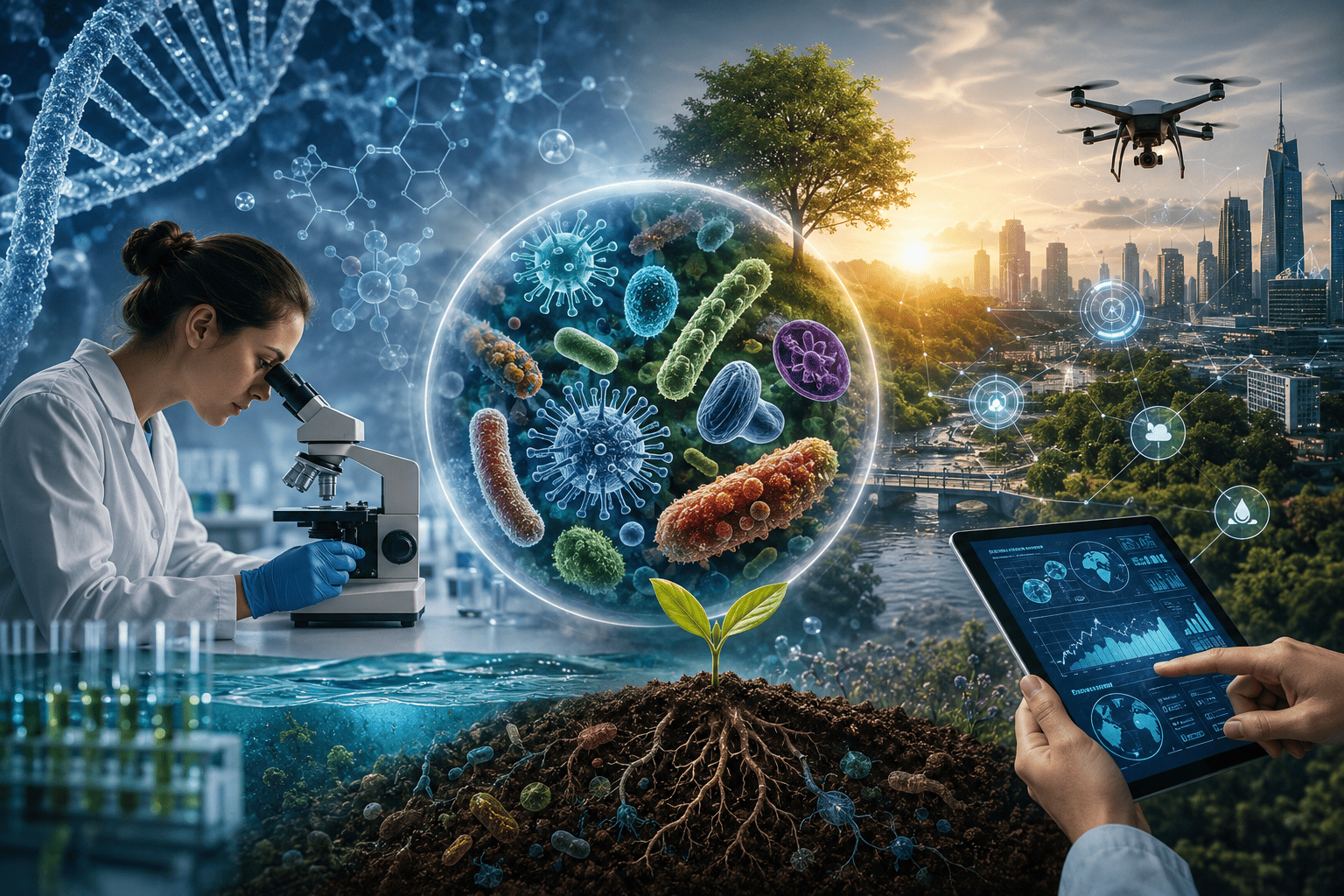
Much of the world around us remains invisible to the naked eye. Microscopic organisms, invisible particles, electromagnetic signals, genetic information, and hidden ecosystems shape human health, technology, climate, and everyday life.
For centuries, the invisible world was largely a mystery. Today, advances in microscopy, biotechnology, artificial intelligence, medical imaging, and environmental science are allowing researchers to observe and understand phenomena that were once beyond human perception.
But a deeper question remains : when will the invisible become one of our greatest tools for protecting human life and the planet?
Quick Facts
- The invisible world includes microorganisms, molecules, atoms, radiation, electromagnetic waves, and microscopic ecological processes.
- Microscopic life is essential to human health, agriculture, food production, and ecosystems.
- Scientists can now detect biological and environmental changes long before they become visible.
- Nanotechnology and biotechnology are creating new approaches to medicine, energy, materials, and environmental protection.
- The greatest challenge is not simply seeing the invisible, but understanding it accurately and using that knowledge responsibly.
Key Findings
The growing ability to detect invisible processes is changing how scientists approach some of the world’s most difficult problems.
- Early detection can save lives.
Modern diagnostic technologies can identify biological changes before serious symptoms appear. This creates opportunities for earlier intervention and more personalized healthcare. - Invisible organisms keep ecosystems functioning.
Bacteria, fungi, and other microorganisms play critical roles in soil fertility, nutrient cycling, decomposition, and the health of plants and animals. - Invisible signals connect the modern world.
Radio waves, infrared radiation, microwaves, and other forms of electromagnetic energy make communication, navigation, medical technologies, and many everyday devices possible. - The microscopic scale may unlock new technologies.
Researchers working with materials at the nanoscale are investigating new possibilities in medicine, electronics, energy storage, and environmental engineering. - Better observation does not automatically produce better decisions.
Scientific measurements require careful interpretation. Errors, incomplete data, misleading correlations, and poor implementation can turn useful information into harmful conclusions.
What Is the Invisible World?
The term “invisible world” is broad. It can refer to anything that exists or operates beyond the normal limits of human vision.
At the smallest scales, this includes atoms, molecules, proteins, viruses, and genetic material. At larger scales, it can include invisible gases, radiation, electromagnetic fields, underground microorganisms, and complex biological interactions.
Some invisible phenomena can be detected with microscopes or sensors. Others require highly specialized instruments.
The important point is that invisibility does not mean insignificance. In many cases, the opposite is true.
A tiny change in a molecule can influence a cell. A microscopic organism can alter an ecosystem. A trace amount of a chemical can affect water quality. An invisible signal can carry information across continents.
How Science Is Making the Invisible Visible
Scientific progress has repeatedly expanded the limits of human perception.
The invention and refinement of the microscope revealed an enormous biological world that had previously gone unnoticed. Later developments in molecular biology allowed scientists to examine DNA, proteins, and cellular processes in increasingly precise ways.
Today, scientists combine advanced instruments with computational analysis and artificial intelligence to identify patterns that would be difficult or impossible to recognize through human observation alone.
These technologies include :
- Advanced microscopy for examining cells and microorganisms.
- DNA sequencing for identifying genetic information.
- Medical imaging for observing structures inside the human body.
- Environmental sensors for detecting pollutants and changes in air or water.
- Satellite observations for monitoring ecosystems, weather, oceans, and land use.
- Artificial intelligence for analyzing enormous quantities of scientific data.
The result is a new scientific capability : not merely observing what is visible, but detecting change before it becomes obvious.
The Invisible and Human Health
Healthcare may be one of the areas where understanding the invisible has the greatest potential impact.
Disease often begins at a microscopic or molecular level. By the time a person notices a symptom, biological changes may already have been occurring for days, months, or even years.
Researchers are therefore developing increasingly sensitive methods for detecting biomarkers, pathogens, genetic changes, and abnormal cellular activity.
The long-term goal is straightforward: identify problems earlier, understand them more precisely, and choose treatments based on the biology of the individual patient.
However, technological capability must be matched by evidence. A promising laboratory discovery is not automatically a reliable medical test or treatment. Clinical validation, independent research, safety monitoring, and ethical oversight remain essential.
The Invisible Ecosystem Beneath Our Feet
One of the most overlooked invisible worlds exists in soil.
A teaspoon of healthy soil can contain an extraordinary diversity of microorganisms. These organisms participate in processes that support plant growth, nutrient cycling, carbon storage, and ecosystem stability.
The consequences are far from microscopic.
Healthy microbial communities can influence agricultural productivity and soil resilience. Conversely, environmental degradation can disrupt these complex biological relationships.
Understanding these hidden systems could therefore become increasingly important as societies face food-security challenges, soil degradation, biodiversity loss, and climate change.
Invisible Technology : From Nanoscience to Smart Sensors
At the nanoscale, materials can behave differently from their larger forms. This has created a major field of research known as nanotechnology.
Scientists are investigating nanoscale materials and structures for applications ranging from medicine and electronics to energy and environmental cleanup.
At the same time, increasingly sophisticated sensors are making it possible to detect extremely small changes in the environment.
Future systems could potentially monitor :
- Air pollution
- Water contamination
- Pathogenic microorganisms
- Industrial emissions
- Changes in soil conditions
- Early signs of infrastructure failure
Such technologies could transform environmental monitoring from occasional testing into something closer to continuous observation.
Main Causes or Results
The growing importance of the invisible world is driven by several major developments :
1. Rapid technological progress
Better microscopes, sensors, sequencing technologies, imaging systems, and computing power allow researchers to collect information at unprecedented levels of detail.
2. The growth of artificial intelligence
AI can identify patterns in large scientific datasets, helping researchers interpret complex biological and environmental information more efficiently.
3. Increasing environmental pressures
Climate change, pollution, biodiversity loss, and resource scarcity are creating a need for earlier and more precise detection of environmental changes.
4. The demand for preventive healthcare
Healthcare systems are increasingly interested in prevention, early diagnosis, personalized medicine, and continuous monitoring rather than relying exclusively on treatment after disease develops.
5. Greater understanding of interconnected systems
Science increasingly shows that human health, animals, microorganisms, soil, water, atmosphere, and climate are interconnected.
The invisible is therefore not a separate universe. It is woven into the visible world.
When Will the Invisible Save Us?
Perhaps the more useful question is not when the invisible will save us, but how we will use what we discover.
Technology alone cannot solve complex human problems. A sensor can detect pollution, but governments and industries must act on the information. A diagnostic tool can identify disease, but patients need access to appropriate care. Scientists can discover environmental risks, but societies must be willing to change harmful practices.
The future promise of invisible technologies lies in early warning and informed action.
Imagine a world in which :
- A sensor detects dangerous contamination before a community is exposed.
- A medical test identifies disease at an early and treatable stage.
- Agricultural monitoring reveals declining soil health before crop yields collapse.
- Environmental systems detect ecological disruption while there is still time to intervene.
- Intelligent networks identify emerging threats and alert decision-makers before they become crises.
These possibilities are not guaranteed. They depend on scientific reliability, responsible governance, affordability, privacy protections, and public trust.
The Risks of Seeing Too Much
Greater visibility also creates new responsibilities.
The ability to collect microscopic biological information or continuously monitor environments can raise difficult questions about privacy, surveillance, ownership of biological data, cybersecurity, and inequality.
There is also a danger in assuming that more data always means more truth.
Measurements can be incomplete. Algorithms can produce misleading results. Scientific findings can be misunderstood or exaggerated. Commercial interests can sometimes encourage premature claims.
For that reason, the future of invisible technologies must be built around transparency, independent verification, ethical standards, and evidence-based decision-making.
A Future Shaped by What We Cannot See
Human history has repeatedly changed when previously invisible phenomena became measurable.
Germs transformed our understanding of disease. Electromagnetic waves revolutionized communication. DNA transformed biology. Modern imaging changed medicine. Sensors and satellites have expanded our understanding of the planet.
The next transformation may come from combining these discoveries.
The real breakthrough may not be a single invention, but an interconnected ability to detect, interpret, predict, and respond to hidden changes.
That could make the invisible one of humanity’s most powerful early-warning systems.
Conclusion
The hidden world is not distant or imaginary. It exists inside our bodies, beneath our feet, in the air we breathe, in the water we drink, and within the technologies that connect modern society.
Science is steadily giving us better ways to observe it.
But seeing the invisible is only the beginning. The true measure of progress will be whether humanity can turn that knowledge into earlier disease detection, healthier ecosystems, safer technology, better environmental protection, and wiser decisions.
So, when will the invisible save us?
Perhaps it already is. Every time an unseen pathogen is detected before it spreads, a hidden environmental danger is identified before it becomes a disaster, or a microscopic biological signal helps guide lifesaving treatment, the invisible is doing precisely what science has taught us to expect from it: quietly shaping the visible world.
The challenge now is to understand that hidden world well enough—and use its knowledge responsibly enough—to let it help build a safer future.
Leave a Reply