
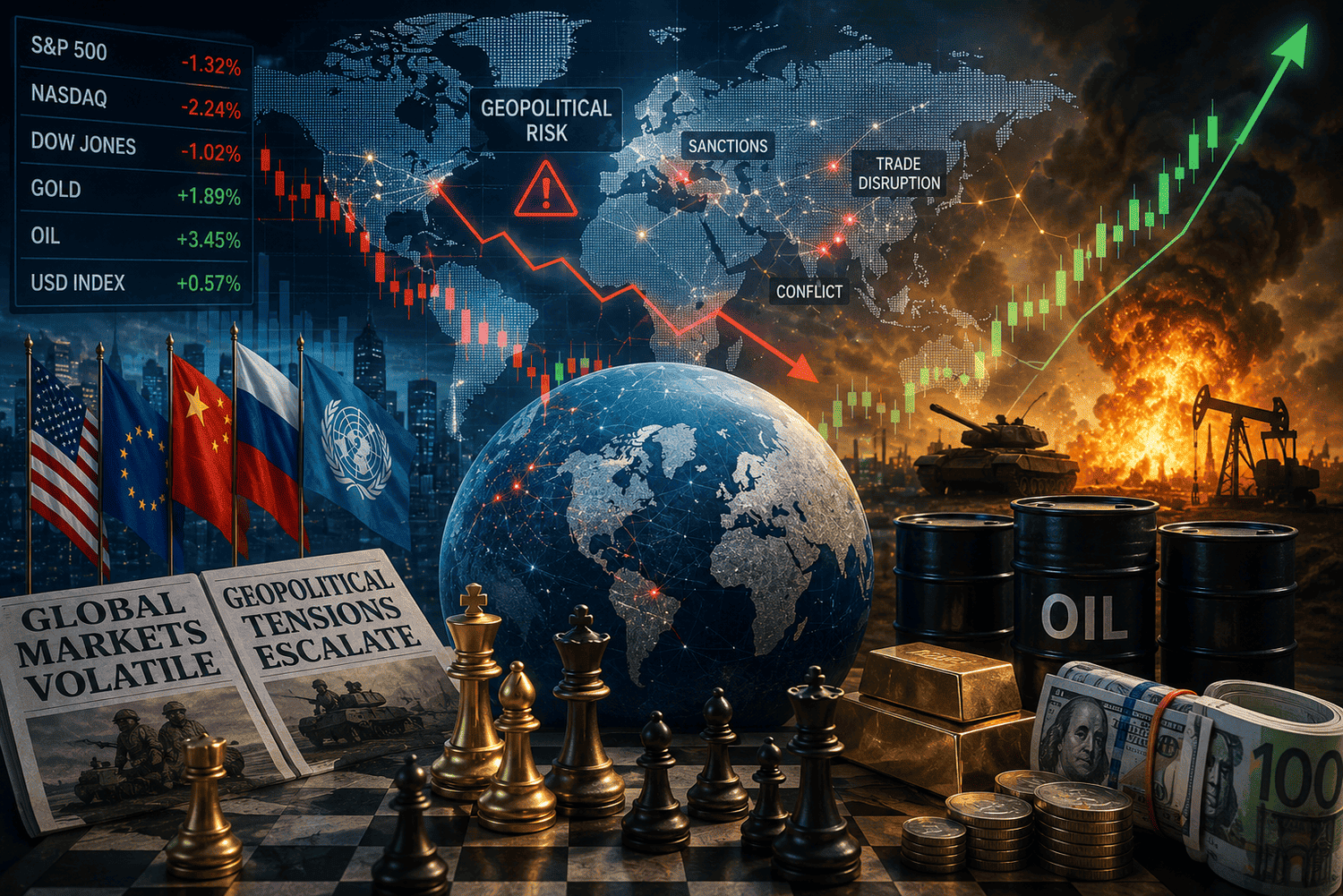
Geopolitical events can move financial markets within minutes. Wars, elections, trade disputes, sanctions, diplomatic tensions, and changes in international alliances can alter investor expectations about economic growth, inflation, interest rates, commodity supplies, and corporate earnings.
The relationship is not always straightforward. Markets may initially fall when a crisis erupts, only to recover once investors assess the economic damage. In other cases, a geopolitical shock can trigger a prolonged period of volatility, particularly when it disrupts energy supplies, trade routes, or global financial flows.
Understanding how geopolitical risk affects stocks, bonds, currencies, and commodities can help investors interpret market movements without confusing short-term reactions with lasting economic trends.
Quick Facts
- Geopolitical risk can affect markets immediately : Financial markets react to new information as investors reassess risk and future economic conditions.
- Oil and other commodities are particularly sensitive : Conflicts involving major producers, pipelines, shipping routes, or strategic resources can cause sharp price movements.
- Currencies often reflect changes in risk perception : Investors may move toward currencies and assets they consider relatively safer during periods of uncertainty.
- Stock-market effects vary by sector : Defense, energy, cybersecurity, and some commodity producers may benefit from certain geopolitical developments, while airlines, tourism, and trade-dependent companies can face pressure.
- Government bonds can respond in different ways : During acute risk-off episodes, demand for highly liquid government securities may rise, although inflation or fiscal concerns can push yields higher.
- The economic impact depends on duration and scale : A brief diplomatic dispute is unlikely to have the same consequences as a prolonged war that disrupts energy, trade, or supply chains.
Top Search Results
When assessing the effect of geopolitical events on financial markets, investors and analysts generally focus on several recurring questions:
- What happened ?
The nature of the event matters. Markets can react differently to an election result, military conflict, sanctions announcement, trade agreement, or diplomatic breakthrough. - How significant is the economic exposure ?
Investors examine whether the event threatens energy supplies, international trade, transportation, production, or access to key raw materials. - Which countries and companies are most exposed ?
Businesses with substantial overseas revenue, imported inputs, or operations in affected regions may experience greater earnings uncertainty. - Will inflation or interest rates change ?
A geopolitical shock that raises energy or food prices can increase inflationary pressure and influence expectations for central-bank policy. - Is the event temporary or structural ?
Markets often absorb short-lived shocks relatively quickly. Longer-lasting changes to trade relationships, supply chains, or international policy can have much deeper effects.
How Geopolitical Events Affect Financial Markets
1. Stock Markets React to Uncertainty
Equity markets price future corporate earnings. When geopolitical tensions increase uncertainty, investors may reduce exposure to companies whose earnings appear vulnerable.
A conflict can affect stocks through several channels :
- Higher energy and transportation costs
- Weaker consumer or business confidence
- Disrupted supply chains
- Reduced international trade
- Lower investment
- Higher borrowing costs
- Increased regulatory or sanctions risk
However, not every stock falls. Companies in industries linked to defense, energy, security, or certain commodities can sometimes benefit from increased government spending or higher prices.
The key point is that geopolitical events do not affect all equities equally. The market response depends on a company’s geography, industry, balance sheet, supply chain, and sensitivity to economic growth.
2. Bond Markets Reflect Risk, Inflation, and Policy Expectations
Government and corporate bonds can react sharply to geopolitical developments.
During periods of acute uncertainty, investors may seek highly liquid government securities, potentially pushing prices higher and yields lower. But this pattern is not universal.
If a geopolitical shock causes energy prices or other input costs to rise significantly, investors may instead anticipate higher inflation and fewer interest-rate cuts. Bond yields can then rise.
This creates an important distinction :
Geopolitical risk can increase demand for safe assets while simultaneously increasing inflation risk.
Which force dominates depends on the circumstances.
3. Currency Markets Price Relative Economic Strength
Foreign-exchange markets respond to changes in economic expectations, interest rates, capital flows, and investor confidence.
A geopolitical crisis can lead investors to move money away from economies perceived as vulnerable and toward markets considered more stable or liquid. At the same time, currencies of commodity-exporting countries can benefit when geopolitical tensions push commodity prices higher.
Currency movements can also affect companies. A weaker domestic currency may make exports more competitive but increase the cost of imported goods, fuel, and raw materials.
4. Commodity Markets Can Experience the Fastest Reactions
Oil, natural gas, gold, agricultural commodities, and industrial metals can respond quickly to geopolitical developments.
Energy markets are particularly sensitive because disruptions to production or transportation can immediately change expectations about future supply.
For example, a conflict affecting a major energy-producing region or a strategically important shipping route may increase the risk premium embedded in energy prices.
Gold can also attract demand during periods of uncertainty, although its price is influenced by many other factors, including real interest rates, the U.S. dollar, and investor positioning.
5. Trade and Supply Chains Can Amplify the Shock
Modern economies depend on complex international supply networks. Geopolitical tensions can expose vulnerabilities that are not immediately visible in financial markets.
Sanctions, export restrictions, tariffs, border closures, or shipping disruptions may force companies to :
- Find alternative suppliers
- Hold larger inventories
- Change production locations
- Pay higher transportation costs
- Delay investment decisions
- Absorb higher operating expenses
If these disruptions persist, the consequences can extend beyond financial markets and affect economic growth and inflation.
Key Results or Causes
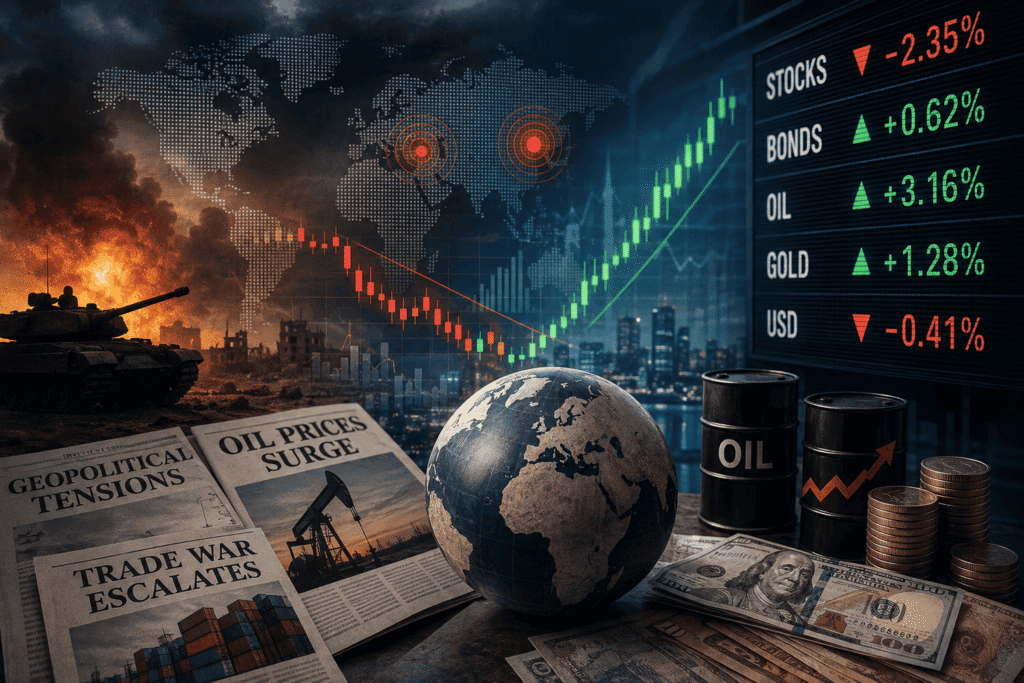
The main mechanisms through which geopolitical events influence financial markets include :
| Geopolitical development | Likely market channel | Potential financial-market effect |
|---|---|---|
| Military conflict | Risk aversion and economic uncertainty | Equity volatility may increase |
| Oil-supply disruption | Higher energy prices | Energy stocks may benefit; transport costs may rise |
| Trade war or tariffs | Higher import costs and weaker trade | Pressure on exposed companies and currencies |
| Economic sanctions | Restricted trade and capital flows | Higher risk premiums for affected markets |
| Political election or leadership change | Policy uncertainty | Currency, bond, and equity volatility |
| Shipping-route disruption | Higher freight and insurance costs | Commodity and inflation concerns |
| Diplomatic agreement or de-escalation | Lower perceived risk | Risk assets may recover |
| Major defense spending | Higher government demand | Potential gains for defense-related industries |
Why Markets Sometimes Recover Quickly
A dramatic market reaction does not necessarily mean that a long-term economic crisis has begun.
Financial markets are forward-looking. Once investors understand the likely consequences of an event, prices can stabilize even while the underlying geopolitical situation remains unresolved.
Three factors often determine whether an initial shock becomes a lasting market trend :
- Economic exposure — How directly the event affects production, trade, energy, or consumption.
- Policy response — How governments and central banks respond to the shock.
- Duration — Whether the disruption lasts days, months, or years.
A limited event with little effect on global economic activity may produce temporary volatility. A prolonged conflict that changes energy markets or international trade patterns can have much broader consequences.
Short-Term vs. Long-Term Market Effects
| Time horizon | Typical market response |
|---|---|
| Hours to days | Sharp moves in stocks, currencies, commodities, and volatility indicators |
| Weeks to months | Repricing of earnings, inflation, interest-rate, and economic-growth expectations |
| Years | Potential changes to supply chains, trade relationships, defense spending, investment patterns, and global capital flows |
This distinction is important because investors can easily mistake a short-term market reaction for a permanent change in economic fundamentals.
Which Sectors Are Most Exposed?
The effect of geopolitical events varies considerably across industries.
Potentially vulnerable sectors
- Airlines and tourism : Higher fuel costs, travel restrictions, and weaker consumer confidence can hurt demand.
- Automotive manufacturing : Global supply chains can be disrupted by shortages of components or raw materials.
- Technology : Export controls and restrictions on advanced technology can affect international sales and production.
- Financial services : Sanctions, capital controls, and market volatility can increase operational and credit risks.
- Retail : Higher import and transportation costs can squeeze margins.
Sectors that may benefit in certain circumstances
- Energy : Supply disruptions can increase oil and gas prices.
- Defense : Governments may increase military expenditure following heightened security concerns.
- Cybersecurity : Rising geopolitical tensions can increase demand for digital security.
- Certain commodity producers : Higher prices for strategically important resources can improve revenues.
These are general patterns rather than investment rules. Market outcomes depend on the specific event, company fundamentals, valuations, and policy response.
How Investors Can Assess Geopolitical Risk
Rather than reacting to every headline, investors can examine the underlying economic transmission mechanisms.
A practical framework is :
- Identify the event. Determine whether it involves trade, military activity, sanctions, elections, energy, or another source of geopolitical risk.
- Measure direct exposure. Consider which countries, industries, commodities, and companies are immediately affected.
- Assess second-order effects. Look for consequences involving inflation, interest rates, currencies, supply chains, and consumer demand.
- Watch policy responses. Government spending, sanctions, tariffs, subsidies, and central-bank decisions can materially change the outcome.
- Consider valuation. A company can have strong fundamentals but still perform poorly if investors have already priced in overly optimistic expectations.
- Separate volatility from fundamentals. A sharp price movement does not automatically indicate a permanent change in an asset’s intrinsic value.
The Role of Central Banks
Central banks can become an important part of the market response to geopolitical shocks.
If an event causes energy and food prices to rise, inflation may become more persistent. A central bank could respond by keeping interest rates higher for longer, depending on its mandate and assessment of the broader economy.
If the shock instead causes a major decline in economic activity, policymakers may face the opposite challenge: supporting growth while containing inflation.
This creates a difficult policy trade-off. A geopolitical event can simultaneously produce slower growth and higher prices, a combination commonly described as stagflationary pressure.
Geopolitical Risk and Investor Psychology
Markets are influenced not only by economic data but also by expectations and investor behavior.
Fear can cause investors to reduce risk rapidly, sometimes producing price movements larger than the immediate economic impact would suggest. Conversely, confidence can return quickly when investors conclude that a crisis is contained.
This is why market volatility can increase substantially around major geopolitical headlines.
Investors should therefore distinguish between :
- The event itself
- The expected economic consequences
- The market’s existing expectations
- The possibility that the event is already reflected in prices
That final point is particularly important. Markets respond to surprises, not simply to bad news.
Conclusion
Geopolitical events affect financial markets by changing expectations about economic growth, inflation, interest rates, trade, commodity supplies, corporate earnings, and investor risk.
The strongest effects usually occur when geopolitical developments have a direct connection to the global economy—for example, through energy supplies, strategic commodities, major trade routes, financial sanctions, or international supply chains.
The market response can differ across asset classes and sectors. Stocks may fall as uncertainty rises, commodities may react to supply concerns, currencies can shift with capital flows and interest-rate expectations, and bonds may respond to competing forces such as safe-haven demand and inflation risk.
For investors, the most useful approach is not to predict every geopolitical event. It is to understand how an event could move through the economy and into asset prices. Evaluating exposure, duration, policy responses, and second-order effects provides a more disciplined way to interpret market volatility.
Ultimately, geopolitical risk is an unavoidable part of investing in a globally connected economy. The better investors understand its transmission channels, the better equipped they are to distinguish temporary market noise from changes that could reshape financial markets for years.
Leave a Reply