
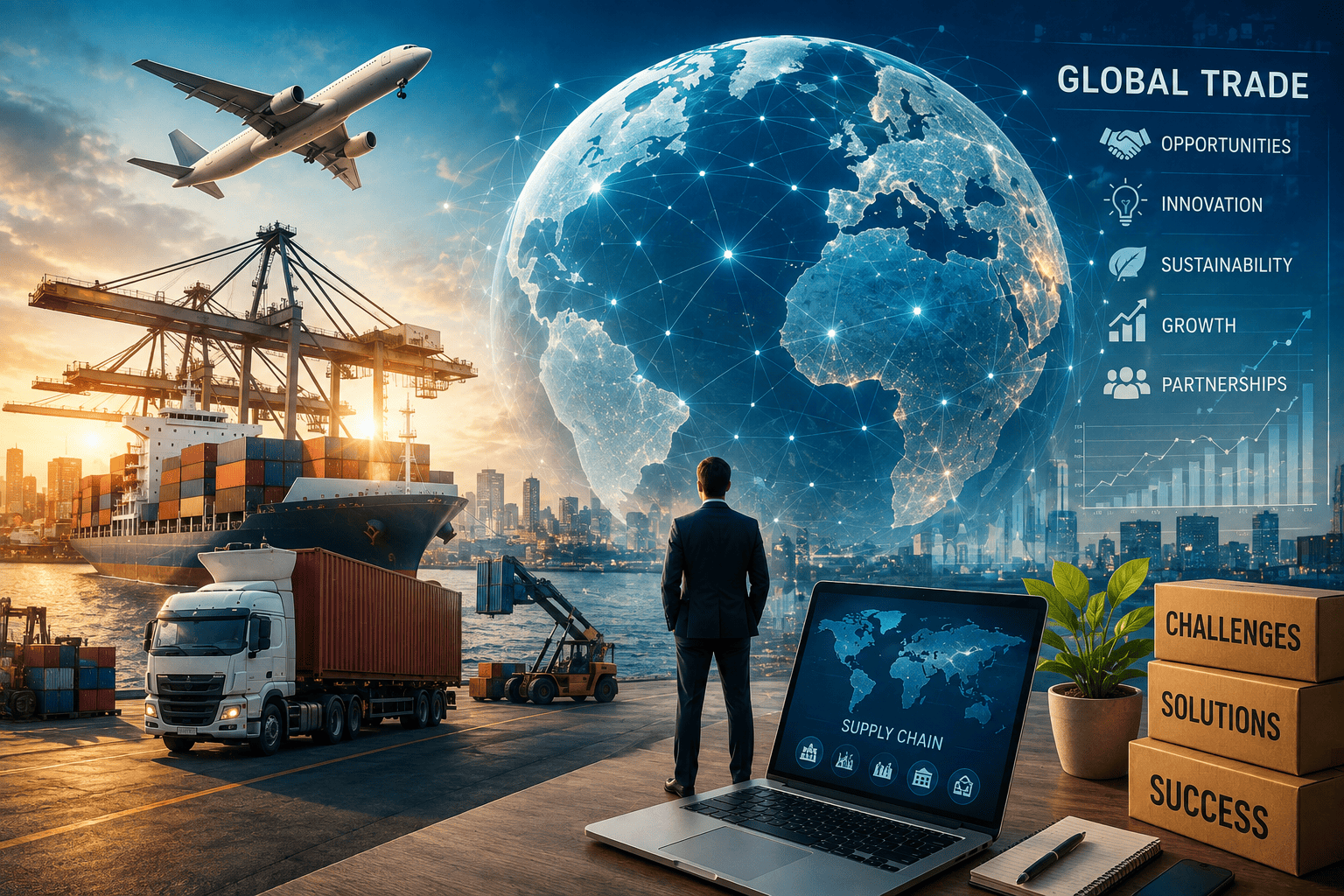
Global trade is entering a period of major change. Businesses, governments, and consumers are adapting to shifting supply chains, geopolitical tensions, changing trade policies, technological advances, and growing pressure for more sustainable economic growth.
For decades, international trade has helped countries expand markets, lower production costs, attract investment, and create economic opportunities. Today, however, the global trading system faces a more complex environment. Trade disputes, regional conflicts, supply chain disruptions, inflation, and new regulations are forcing companies to rethink how and where they do business.
At the same time, these challenges are creating new opportunities. Companies that diversify their suppliers, invest in technology, enter emerging markets, and build more resilient supply chains can strengthen their position in the global economy.
Quick Facts About Global Trade
- Global trade connects economies : Countries depend on international markets for goods, services, raw materials, technology, and investment.
- Supply chain resilience has become a priority : Businesses are increasingly looking beyond the lowest-cost supplier and considering reliability and geographic diversification.
- Digital trade is expanding : E-commerce, digital services, and online business platforms are making international markets more accessible.
- Trade policy matters : Tariffs, export controls, sanctions, and new regulations can significantly influence international business decisions.
- Sustainability is becoming increasingly important : Environmental standards and consumer expectations are changing how companies produce and transport goods.
Key Research Findings
Recent trends in the global economy point to several important developments :
- Globalization is changing rather than disappearing. International trade remains essential, but companies are becoming more selective about where they source, manufacture, and sell.
- Supply chain diversification is gaining importance. Businesses are seeking alternative suppliers and production locations to reduce their exposure to disruptions.
- Regional trade is becoming more significant. Companies are increasingly considering markets and suppliers closer to their main operations.
- Technology is reshaping international commerce. Digital platforms and improved logistics are helping smaller businesses reach customers abroad.
- Sustainability is influencing trade decisions. Environmental requirements are increasingly affecting production, transportation, investment, and market access.
The Main Challenges Facing Global Trade
1. Geopolitical Tensions
Political tensions between major economies can have consequences far beyond national borders. Trade restrictions, tariffs, sanctions, and export controls can raise costs and make international transactions more complicated.
For companies operating across several countries, political uncertainty can also make long-term planning more difficult. A supplier or market that appears attractive today may become less accessible if trade policies change.
2. Supply Chain Disruptions
The global economy has demonstrated how quickly disruptions can affect international commerce. Problems involving transportation, energy, raw materials, ports, or manufacturing can create delays and increase prices.
As a result, many companies are moving away from relying heavily on a single supplier or production center. Supply chain resilience is now an important part of business strategy.
3. Rising Costs and Economic Uncertainty
Inflation, higher energy prices, exchange-rate movements, and changing interest rates can influence the cost of international trade.
For exporters and importers, currency fluctuations can affect profit margins. Meanwhile, higher transportation and production costs can make products less competitive in foreign markets.
4. Protectionism and Changing Trade Policies
Governments sometimes introduce measures designed to protect domestic industries. These can include tariffs, subsidies, import restrictions, and local-content requirements.
While such policies may support specific industries, they can also increase costs for businesses and consumers and create uncertainty for international companies.
5. Environmental and Sustainability Requirements
The transition toward a lower-carbon economy is creating both pressure and opportunity.
Companies increasingly need to consider carbon emissions, responsible sourcing, waste reduction, and sustainable production. Businesses that adapt early may gain an advantage, while those that fail to meet new standards could face higher costs or reduced access to certain markets.
The Main Opportunities in Global Trade
Despite these challenges, international commerce continues to offer significant opportunities.
1. Emerging Markets
Growing economies offer businesses access to new customers, suppliers, investment opportunities, and production networks.
Companies that understand local consumer preferences and build strong partnerships can benefit from expanding demand in emerging markets.
2. Digital Trade and E-Commerce
Digital technology has reduced some of the traditional barriers to international business.
A small company can now use an online platform to reach customers in other countries without establishing physical stores in every market. Digital payments, online marketing, cloud services, and modern logistics have further supported this transformation.
Digital trade is therefore becoming an important route for small and medium-sized businesses seeking international growth.
3. Supply Chain Diversification
Supply chain disruption is a challenge, but it also creates opportunities for companies and countries that can offer reliable alternatives.
Businesses are exploring multiple suppliers, new manufacturing locations, and regional production networks. Countries that provide stable infrastructure, skilled workers, competitive costs, and predictable regulations may attract new investment.
4. Innovation and Technology
Technology can make international trade faster and more efficient.
Automation, data analysis, digital documentation, improved logistics systems, and artificial intelligence can help companies manage international operations and identify changes in demand.
The greatest benefits, however, come when technology is combined with effective management and reliable infrastructure.
5. Sustainable Trade
The growing demand for environmentally responsible products is creating new markets.
Businesses investing in cleaner production, sustainable materials, energy efficiency, and responsible supply chains can potentially strengthen their reputation and meet changing customer expectations.
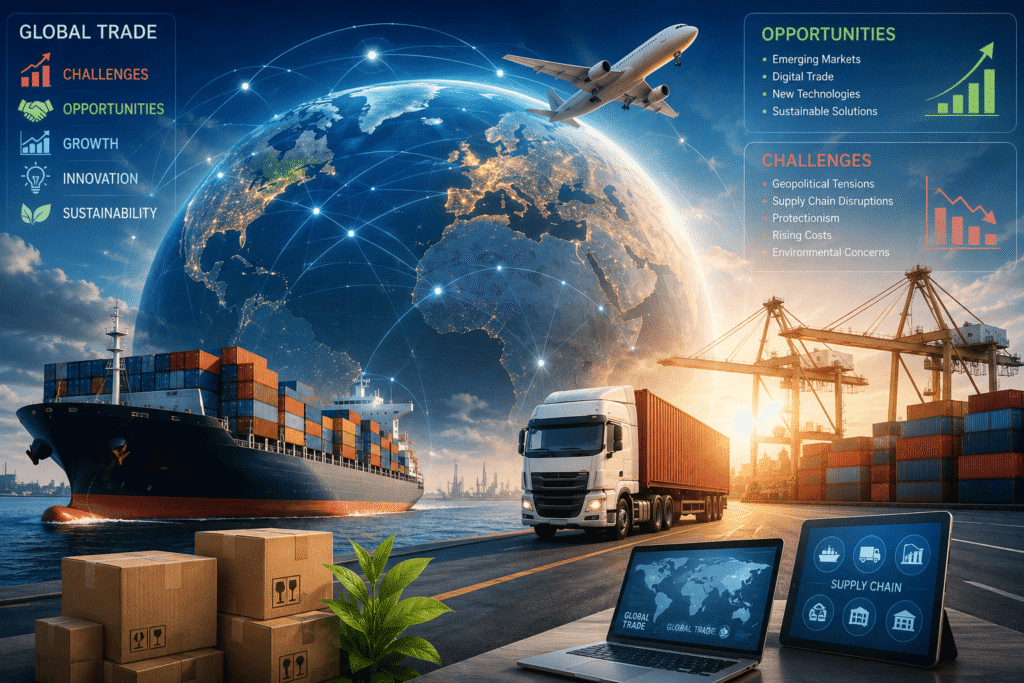
Global Trade : Challenges vs. Opportunities
| Challenge | Business Impact | Potential Opportunity |
|---|---|---|
| Geopolitical tensions | Greater uncertainty and higher trade costs | Diversification into alternative markets |
| Supply chain disruptions | Delays and increased expenses | Development of resilient supply networks |
| Protectionism | Tariffs and market barriers | Local production and regional partnerships |
| Economic volatility | Uncertain demand and profit margins | Flexible pricing and market diversification |
| Sustainability requirements | Higher compliance costs | Growth in green products and services |
| Digital transformation | Pressure to modernize | Wider access to international customers |
What Businesses Can Do
Companies cannot control every global development, but they can improve their ability to respond.
Diversify Markets and Suppliers
Depending too heavily on one country, supplier, or customer exposes a company to unnecessary risk. Geographic diversification can provide greater flexibility when conditions change.
Invest in Market Intelligence
Businesses need reliable information about consumer demand, regulations, competitors, exchange rates, and political developments. Better information allows companies to make more informed international decisions.
Strengthen Supply Chain Resilience
Companies should identify critical suppliers and potential bottlenecks before a disruption occurs. Maintaining alternative sources and improving communication with suppliers can reduce vulnerability.
Embrace Digital Commerce
Businesses that want to expand internationally should consider digital sales channels, online customer service, digital marketing, and secure payment solutions.
Build Sustainable Business Models
Sustainability should increasingly be viewed as a long-term business strategy rather than simply a regulatory requirement. Efficient use of energy and materials can reduce costs while helping companies meet changing market expectations.
Key Reasons Behind the Current Transformation
The changing global trade environment is being driven by several interconnected forces :
- Geopolitical competition is influencing investment and supply chains.
- Technological change is transforming how products and services cross borders.
- Consumer expectations are encouraging greater transparency and sustainability.
- Economic uncertainty is pushing companies to manage risk more carefully.
- Government policies are reshaping market access and international competition.
- Supply chain experience has encouraged businesses to prioritize resilience alongside cost efficiency.
These factors suggest that the future of international trade will not simply be about moving more goods across borders. It will increasingly be about building reliable, flexible, digitally connected, and sustainable international business networks.
The Future of Global Trade
The next phase of globalization is likely to be more diversified and strategically managed.
International trade will remain an important source of economic growth, but companies may rely less on highly concentrated supply chains. Regional partnerships, digital commerce, advanced logistics, and sustainable production are likely to play a larger role.
For governments, the challenge will be to balance national economic interests with the benefits of international cooperation. Open and predictable trade rules can help businesses invest and plan, while targeted policies may be needed to address strategic risks.
For companies, flexibility will be increasingly valuable. Businesses that can adapt quickly to changing regulations, customer preferences, technology, and supply conditions will be better positioned to compete internationally.
Conclusion
Global trade is not disappearing; it is evolving. The current period presents serious challenges, from geopolitical tensions and supply chain disruptions to rising costs and changing environmental requirements. Yet these same pressures are creating opportunities for businesses willing to adapt.
The strongest companies in the emerging global economy are likely to be those that combine market diversification, supply chain resilience, digital innovation, sustainability, and informed decision-making.
Ultimately, the future of global trade will depend not only on how countries manage competition, but also on how effectively businesses and governments cooperate to create a more resilient, inclusive, and sustainable international trading system.
Final Takeaways
- Global trade remains essential to economic activity and business growth.
- Resilience is becoming as important as cost efficiency.
- Digitalization is lowering barriers to international markets.
- Diversification can reduce exposure to geopolitical and supply chain risks.
- Sustainability is becoming a competitive factor, not merely a regulatory issue.
- Businesses that remain flexible, innovative, and internationally informed are best placed to benefit from the next phase of global commerce.
Leave a Reply