
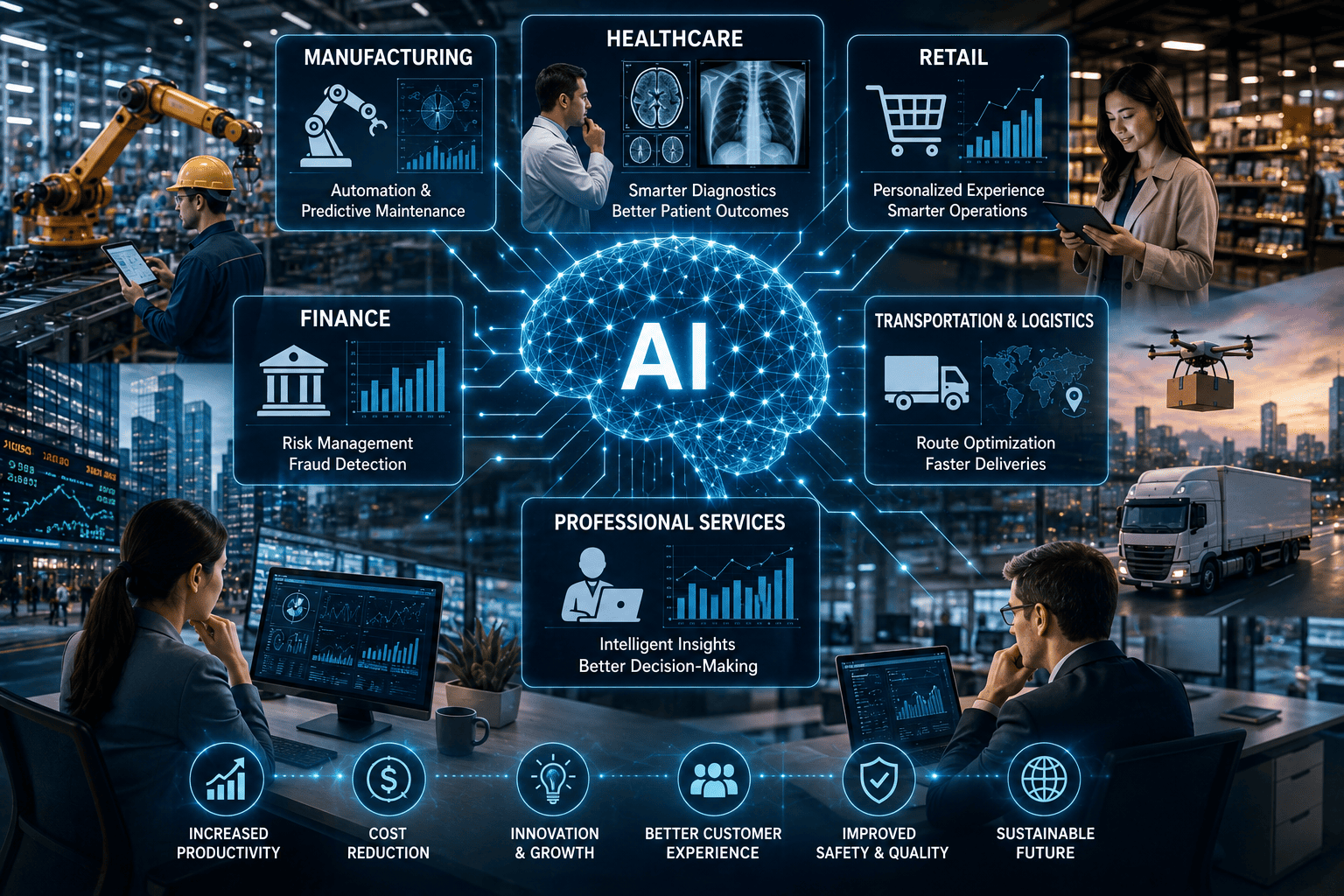
Artificial intelligence is moving beyond the experimental stage and becoming a practical force across the global economy. From healthcare and manufacturing to finance, retail, transportation, and professional services, advances in AI are changing how organizations operate, make decisions, serve customers, and develop new products.
The shift is not simply about replacing human work with machines. Increasingly, AI is being used to support human decision-making, automate repetitive tasks, improve productivity, and create new business opportunities. At the same time, organizations face important questions about workforce skills, data privacy, reliability, cybersecurity, and responsible AI governance.
The result is a more complex transformation : industries that successfully combine AI with human expertise may gain an advantage, while organizations that adopt the technology without adequate planning may face new operational and reputational risks.
Quick Facts
- AI adoption is expanding : McKinsey’s 2025 global survey found that almost all respondents said their organizations were using AI, although nearly two-thirds had not yet begun scaling it across the enterprise.
- AI is reshaping jobs rather than simply eliminating them : The International Labour Organization estimates that one in four workers worldwide is in an occupation with some degree of exposure to generative AI, while most jobs are more likely to be transformed than made redundant.
- Productivity could rise : OECD research estimates that AI could add roughly 0.4 to 1.3 percentage points to annual labour productivity growth in some highly exposed G7 economies under its scenarios.
- Healthcare is already adopting AI : WHO/Europe reported in 2025 that 32 of 50 surveyed countries in its European Region were already using AI-assisted diagnostics.
- Skills are changing rapidly : The World Economic Forum estimates that almost 40% of workers’ core skills could change by 2030.
Key Research Findings
Recent research points to several important conclusions about the future of AI in business and industry:
- Adoption is ahead of large-scale transformation. Many organizations are experimenting with AI, but fewer have successfully integrated it throughout their operations.
- Human-AI collaboration is becoming central to the workplace. The ILO’s research suggests that augmentation—AI supporting workers—is likely to be more common than complete automation for many occupations.
- Productivity gains will depend on implementation. AI does not automatically produce economic value. Infrastructure, skills, organizational change, and the ability to redesign workflows all influence the results.
- Trust and governance are becoming strategic priorities. NIST recommends considering reliability, safety, security, transparency, privacy, and fairness throughout the AI lifecycle.
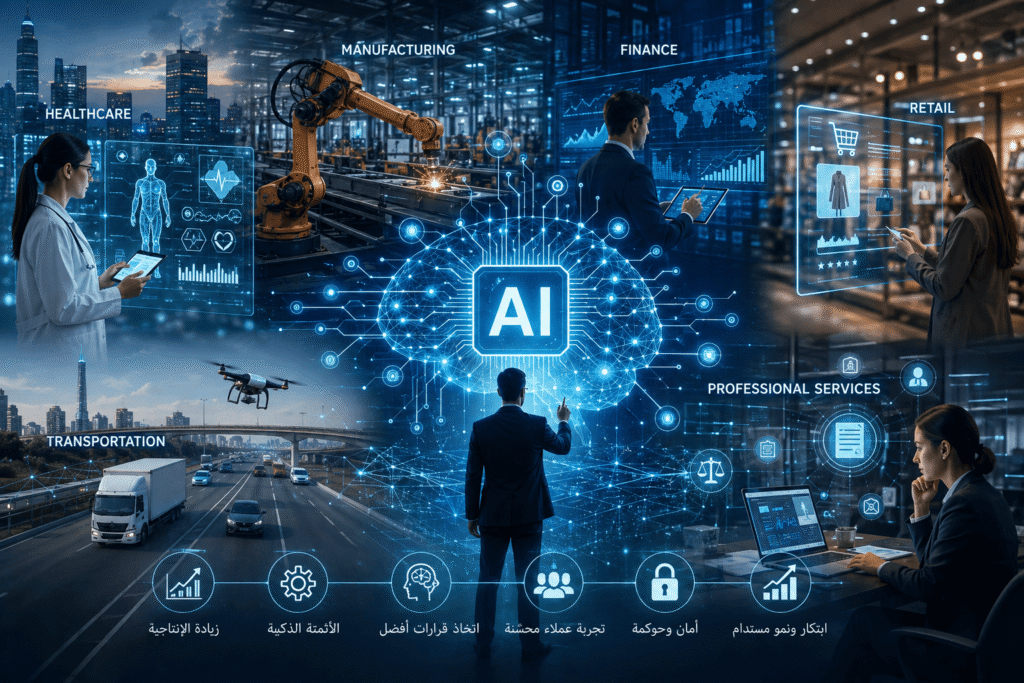
How AI Is Changing Major Industries
1. Healthcare : From Administrative Support to Smarter Care
Healthcare is one of the most closely watched areas of AI innovation. Hospitals and health systems are using AI for applications such as medical imaging, administrative support, patient communication, and information management.
AI can help clinicians process large amounts of information and identify patterns that may be difficult to detect manually. It can also reduce some routine administrative work, potentially giving healthcare professionals more time for patients.
However, healthcare demonstrates why AI adoption must be accompanied by strong safeguards. WHO emphasizes that AI in health requires attention to patient safety, privacy, fairness, accountability, and regulation.
The future is therefore unlikely to be “AI replacing doctors.” A more realistic model is AI-assisted healthcare, in which technology supports professionals while humans remain responsible for critical decisions.
2. Manufacturing : More Predictive and Efficient Production
In manufacturing, AI is helping companies improve production planning, quality control, maintenance, and supply-chain management.
For example, AI systems can analyze equipment data to identify signs of potential failure before a breakdown occurs. Manufacturers can also use AI to detect product defects and improve inventory or production decisions.
The OECD has identified applications such as reducing machine downtime and improving supply-chain management as important ways AI can raise productivity in manufacturing.
The broader change is significant: factories are becoming more data-driven, responsive, and automated, while workers increasingly need skills that combine technical knowledge with problem-solving and operational expertise.
3. Finance : Faster Analysis and More Personalized Services
Financial institutions are using AI to support fraud detection, customer service, risk assessment, document processing, and financial analysis.
AI can examine large volumes of transactions and identify unusual patterns quickly. Banks and other financial organizations can also use AI-powered tools to respond to routine customer requests and streamline internal processes.
Yet finance also illustrates the risks of relying too heavily on automated decisions. Errors, biased data, cybersecurity threats, and a lack of transparency can have serious consequences.
As a result, human oversight and effective AI governance remain essential, particularly when AI influences decisions that affect customers’ finances.
4. Retail : Personalization and Smarter Operations
Retailers are increasingly using AI to understand customer preferences, forecast demand, optimize inventory, and improve digital customer experiences.
Instead of treating every customer the same, AI can help businesses identify patterns in purchasing behavior and provide more relevant recommendations. Behind the scenes, demand forecasting can help retailers reduce excess inventory while improving product availability.
The next stage will likely involve more AI-driven business processes, including systems that can coordinate several routine tasks with limited human intervention.
5. Transportation and Logistics : Better Planning and Automation
Transportation companies face complex challenges involving routes, fuel consumption, vehicle maintenance, delivery schedules, and fluctuating demand.
AI can help analyze these variables and identify more efficient ways to manage logistics. In warehouses and distribution centers, AI can also work alongside robotics and automated systems to improve the movement of goods.
However, autonomous transportation remains a field where safety, regulation, infrastructure, and public trust are just as important as technological capability.
6. Professional Services : AI Becomes a Digital Work Assistant
Law, marketing, consulting, accounting, software development, research, and other professional services are experiencing rapid changes from generative AI.
Instead of spending hours on routine drafting, summarization, research, or data-processing tasks, professionals can increasingly use AI as an assistant.
This does not mean expertise becomes irrelevant. In many cases, it becomes more important because professionals must determine whether an AI-generated result is accurate, appropriate, and useful.
McKinsey’s 2025 research illustrates this transition: organizations reported experimentation with AI agents and use-case-level benefits, but relatively few had yet translated those gains into broad enterprise-level financial impact.
AI’s Impact on Jobs and Skills
One of the biggest questions surrounding the future of artificial intelligence is what happens to employment.
The evidence suggests that the answer is more complicated than mass replacement.
The ILO’s 2025 analysis found that one in four workers globally is in an occupation with some exposure to generative AI, but it concluded that most jobs are more likely to be transformed than eliminated because human involvement remains necessary for many tasks.
The World Economic Forum’s Future of Jobs Report 2025 also points to significant labour-market change. Its employer survey projects 170 million jobs created and 92 million displaced by 2030 across the major trends shaping the labour market, producing a net increase of 78 million jobs.
| Area | Likely AI Impact | Human Role |
|---|---|---|
| Customer service | Automating routine requests | Complex cases and relationship management |
| Healthcare | Supporting diagnosis and administration | Clinical judgment and patient care |
| Manufacturing | Predictive maintenance and quality control | Operations, supervision, and problem-solving |
| Finance | Fraud detection and analysis | Risk judgment and accountability |
| Marketing | Content and customer analysis | Strategy, creativity, and brand judgment |
| Software | Faster development and testing | Architecture, verification, and decision-making |
The implication is clear : AI skills alone will not be enough. Workers will increasingly need a combination of digital literacy, analytical thinking, creativity, communication, adaptability, and industry-specific expertise.
The Main Reasons AI Is Transforming Industries
Several forces are accelerating the adoption of AI.
1. Greater Access to AI Tools
AI capabilities that once required specialized research teams are increasingly available through commercial software and cloud services. This lowers the barrier for businesses that want to experiment with AI.
2. Pressure to Improve Productivity
Businesses are under constant pressure to reduce waste, improve efficiency, and deliver better services. AI offers another way to automate repetitive activities and support faster decision-making.
3. Growth of Digital Data
Modern organizations generate enormous amounts of information. AI can help turn that information into useful insights, provided the underlying data is reliable and appropriately managed.
4. Advances in Generative AI
Generative AI has expanded the range of tasks that software can assist with, including writing, coding, image creation, research, summarization, and customer communication.
5. Competitive Pressure
As more organizations experiment with AI, companies may adopt the technology not only to reduce costs but also to avoid falling behind competitors.
The Challenges Businesses Must Address
AI adoption also introduces substantial challenges.
Accuracy and Reliability
AI systems can produce incorrect or misleading outputs. Businesses therefore need processes for verification, testing, and human review, particularly in high-impact applications.
Data Privacy
Organizations must understand what data AI systems use, where that data is stored, and how it is protected. Sensitive information requires particular care.
Cybersecurity
AI creates new opportunities for attackers as well as defenders. NIST identifies security and resilience as core elements of trustworthy AI.
Bias and Fairness
If AI systems rely on incomplete or biased information, their outputs may reproduce or amplify those problems. This is especially important in areas such as hiring, lending, healthcare, and public services.
Workforce Disruption
Some tasks and occupations will shrink while others grow. Employers therefore face a major responsibility to provide reskilling and upskilling opportunities.
Unequal Access
The benefits of AI will not automatically be distributed evenly. OECD research warns that countries and businesses with weaker digital infrastructure, fewer skills, limited financing, or lower technological capacity may struggle to capture the same productivity gains.
What Businesses Should Do Next
Organizations looking to benefit from AI technology should focus on practical implementation rather than adopting AI simply because it is fashionable.
A strong approach includes :
- Identify high-value problems before choosing an AI solution.
- Start with measurable use cases where benefits and risks can be evaluated.
- Keep humans involved in important decisions.
- Invest in employee training alongside technology.
- Protect data and privacy from the beginning.
- Test AI systems continuously for accuracy, security, and unintended consequences.
- Establish clear accountability for AI-supported decisions.
- Measure business outcomes, not just AI usage.
NIST’s AI Risk Management Framework provides a voluntary structure built around governing, mapping, measuring, and managing AI-related risks.
What the Future of AI in Industry May Look Like
The next phase of AI is likely to be less about isolated chatbots and more about AI integrated into everyday business processes.
AI systems are increasingly moving toward the role of digital assistants that can help employees gather information, complete routine work, coordinate processes, and support decisions. At the same time, businesses are experimenting with AI agents that can perform sequences of tasks rather than responding to a single request. McKinsey reported in 2025 that 62% of surveyed organizations were at least experimenting with AI agents.
This development could change the structure of work itself. Employees may spend less time on repetitive activities and more time on judgment, creativity, relationships, problem-solving, and oversight.
The organizations most likely to benefit will not necessarily be those with the most AI tools. They will be those that know where AI creates genuine value and where human expertise remains indispensable.
Key Takeaways
- AI is becoming a mainstream business technology, but many organizations are still learning how to scale it effectively.
- Healthcare, manufacturing, finance, retail, transportation, and professional services are among the sectors being reshaped.
- The strongest near-term impact may come from human-AI collaboration, rather than complete automation.
- Workforce skills will change significantly, making continuous learning increasingly important.
- AI can improve productivity, but the size of the benefit depends on adoption, infrastructure, skills, and organizational change.
- Responsible AI governance is essential to address privacy, security, bias, reliability, and accountability.
- The future competitive advantage will come from combining AI capabilities with human judgment and industry expertise.
Conclusion
The evolution of artificial intelligence technologies is changing the future of industries—but the transformation is not simply a story of machines replacing people.
AI is becoming a new layer of business infrastructure that can help organizations analyze information, automate routine work, improve services, and develop new products. Its greatest impact may come when companies redesign how work is performed rather than merely adding AI to existing processes.
At the same time, the technology creates real challenges. Businesses must manage risks, protect personal data, prepare workers for changing roles, and ensure that AI-supported decisions remain accountable and trustworthy.
The central question is therefore no longer whether AI will influence the future of industry. It already is. The more important question is how businesses, workers, governments, and communities will shape that transformation so that technological progress produces lasting economic and social value.
Leave a Reply